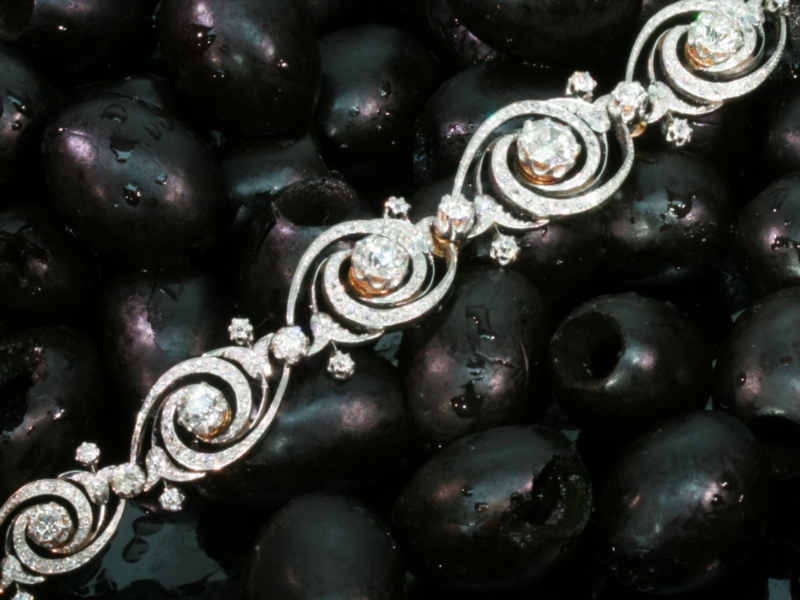

All olives are equal (but some are more equal than others)

A one-of-a-kind antique bracelet set with 7.20 carats of diamonds, crafted by the illustrious Emile Olive. This very bracelet is depicted in the "Bible of Antique Jewellery", Henri Vever’s La Bijouterie Française au XIXe Siècle (third volume, page 533), and in its English translation French Jewelry of the Nineteenth Century (page 1025).
Henri Vever writes about Emile Olive:
"Emile Olive (1853-1902) succeeded Le Saché as a designer in Falize's firm. An artist of lively intelligence and infinite taste, he spent thirty years dedicating his body and soul to our beloved art. It is evident that Olive’s gift for geometry was hardly appreciated by his father, an accountant, as he sent him to work with a cheese and bean seller in Rue de la Verrerie. Such an environment seemed unlikely to foster the development of an artistic vocation. However, the young man felt such a need to draw and had such a highly developed sense of decoration that he even found curious ornamental motifs in the stains and fissures of the old shop walls, and in the mould on the cheeses of his employer!"
The Belle Époque (French for "Beautiful Era") was a period in European social history that began in the late 19th century and lasted until World War I. Occurring during the time of the French Third Republic and the German Empire, the Belle Époque was named in retrospect, when it began to be considered a "golden age". During this time, the major powers of Europe experienced improvements in everyday life through new technologies, and the commercial arts adapted Renaissance and 18th-century styles into modern forms. This epoch overlaps the end of the Victorian Era and the period known as the Edwardian Era.
(Click here to read much more about this magnificent piece.)