

Developments in male construction phases
Christiaan Frederik (Chris) Steenbergen completed his goldsmith training during World War II at the Institute of Applied Art in Amsterdam (IvKNO), which is now known as the Rietveld Academy. In 1946, he earned his master’s certification and began working as an independent jeweller at the Leliegracht in Amsterdam. After his graduation, he briefly collaborated with other well-known jewellery designers, Archibald Dumbar and Esther Swart-Hudig. Steenbergen participated in both national and international exhibitions, and on the occasion of his 65th birthday, a retrospective of his work was held at the Museum Boijmans Van Beuningen in Rotterdam. In 2000, he was honoured with an award from the Foundation for Visual Arts, Design and Architecture for his complete oeuvre.
As a member of the Society of Cooperating Craft Artists (GSA), he regularly exhibited his jewellery. Characteristic of Steenbergen's jewellery designs are sleek and simple forms that emerge from basic shapes such as the square, circle, and ellipse. In combination with gold and silver, Steenbergen occasionally incorporated other materials, such as coloured perspex, ebonite, rock crystal, and slate. The developments in the visual arts were a significant source of inspiration for him. His designs were influenced by the Bauhaus movement, the sculptures of artists such as Henry Moore and Antoine Pevsner, and abstract constructivism. In later years, architecture became a major source of inspiration for his work.
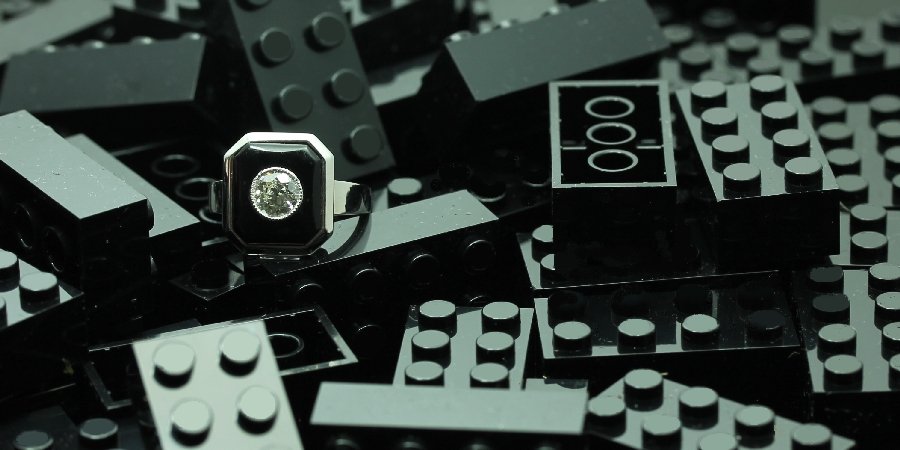
Click here to get to this white gold ring in Art Deco style by artist jeweler Chris Steenbergen.