

Eureka! The most devious way to test gold.
The most famous story about Archimedes (287 BC – 212 BC) goes as follows: King Hiero II gave a goldsmith pure gold to make a crown for him. However, the king doubted the honesty of the goldsmith and tasked Archimedes with finding out whether the gold had been tampered with by adding silver, without damaging the crown.
According to the story, as told by the Roman writer Vitruvius, Archimedes was taking a bath when he noticed the water level rising, leading to his discovery of what we now know as Archimedes' principle (a body immersed in a fluid experiences an upward force equal to the weight of the fluid it displaces). So thrilled was he with this discovery that he leapt out of the bath, forgot to get dressed, and ran through the streets shouting "Eureka!" (I have found it!). The test on the crown was conducted, and indeed, silver had been mixed in.
But here the myth starts to unravel. Although it’s a fascinating tale, literature suggests that this story is likely more of a well-told anecdote than a strictly historical event. Vitruvius recorded the story more than 200 years after it supposedly occurred, casting doubt on its accuracy. Moreover, Archimedes could have used a much simpler and more accurate method to test the gold—the touchstone and acid test, a technique known centuries before his time.
The story also fails to mention whether the crown contained stones or hollow spaces, which would have made the water displacement method less effective. And how pure was 'pure' gold at the time? In those days, gold was around 88 to 90% pure, the best they could achieve. So, even if the bathtub tale isn’t true, it remains a wonderful story.
What ultimately lingers is the image of a mad scientist running naked through the streets after discovering something that, in the end, wasn’t really useful in our profession. But hey, it sure makes for a great story!
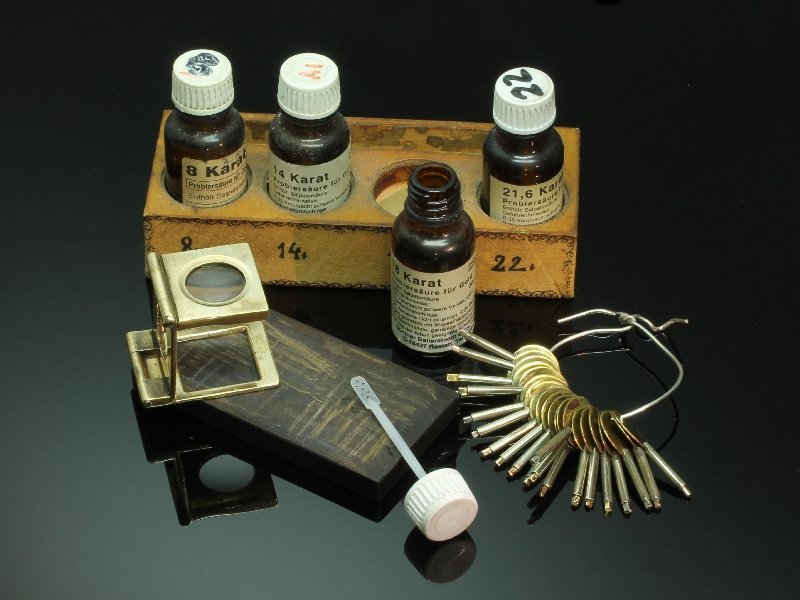
In the picture, you see a touchstone, some bottles of acid to test the various alloys, and some sample-needles with standardized alloys of gold, platinum, and silver as we use these in our daily work at Adin.
Our well-tested collection is available in most currencies.
Click here to view our well-tested collection.