
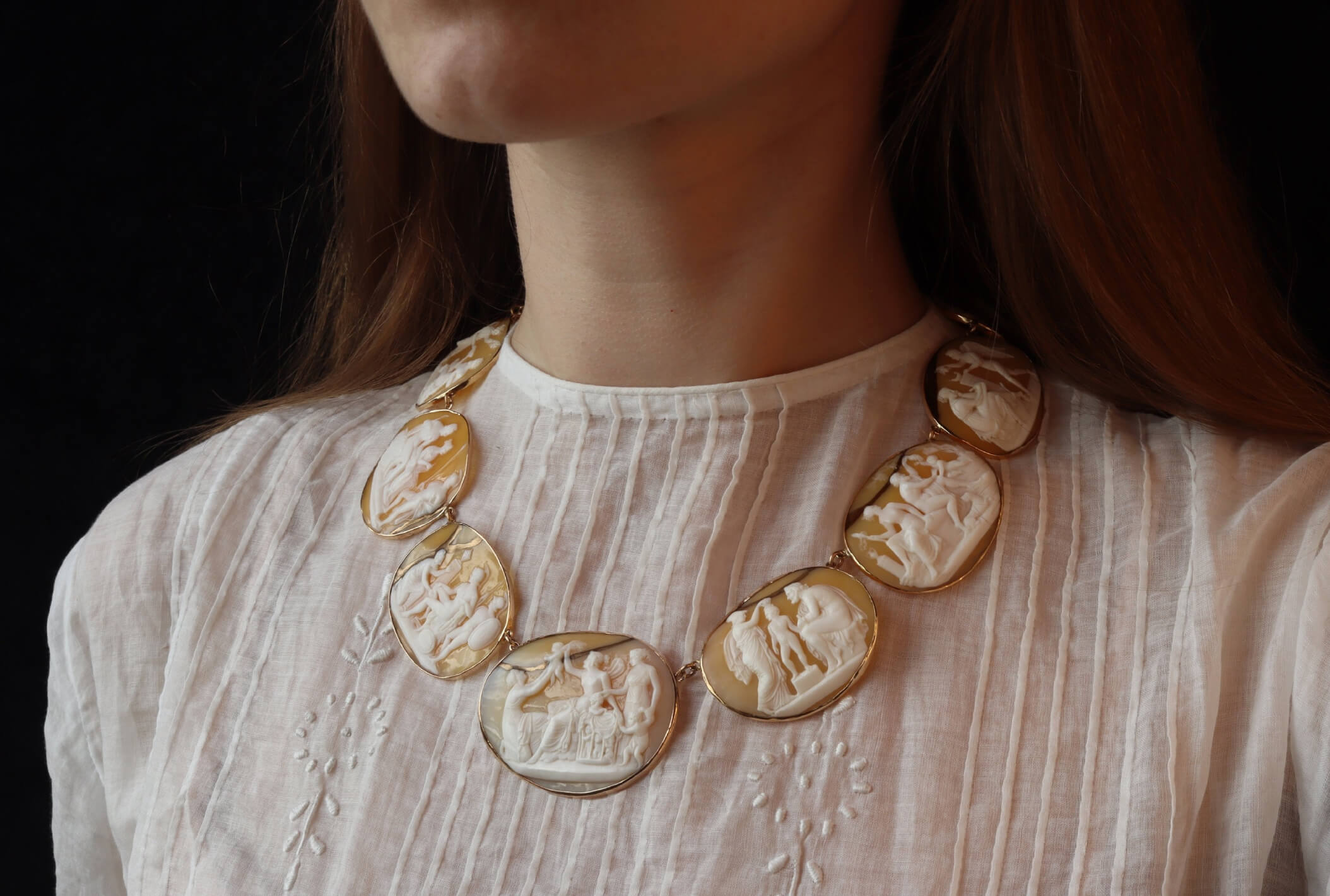
1. Introduction
Archaeological Revival jewellery emerged in the nineteenth century from a renewed fascination with the ancient world. Excavations at Pompeii, Herculaneum and in Etruscan tombs revealed objects whose craftsmanship and technical ingenuity impressed contemporary viewers, and museums, publications and scholarship broadened interest in Greek, Roman and Egyptian cultures.
Jewellers studied antiquities closely and revived techniques such as granulation and filigree style wirework, which had largely disappeared from mainstream Western European jewellery making. They also adopted micromosaic work, a specialised Roman craft that had developed from the late eighteenth century onwards. Rather than copying ancient ornaments, nineteenth century makers reinterpreted these ancient forms and materials for contemporary jewellery.
2. Historical and Cultural Context
Archaeological Revival jewellery was driven by excavation, scholarship and collecting. Etruscan metalwork in Italy, ancient Greek sites and sculpture, and Roman antiquities associated with the Grand Tour provided both technical and thematic models. Egypt also captured the European imagination through missions, travel literature and museum acquisitions, long before the twentieth century discovery of the tomb of Tutankhamun.
Publications, museum catalogues and international exhibitions disseminated knowledge of ancient art to a growing educated public. Jewellers travelled, studied collections and consulted scholars to recover ancient techniques. In Italy this aligned with cultural nationalism, while in France and Britain classical revivalism formed part of wider intellectual and artistic reforms.
3. Visual Characteristics and Materials
Across the revivals, colour and texture play essential roles. Surfaces are often satin finished, stones are chosen for tone rather than brilliance, and patterns are organised with rhythmic clarity.
Settings are integrated into the overall composition, reflecting the structural unity typical of ancient crafts. While each revival has its distinctive vocabulary, they share a commitment to technique and proportion that distinguishes them from broader nineteenth century historicism.
4. Function and Meaning
While classical motifs often carry mythological associations, the meaning of Archaeological Revival jewellery lies primarily in its connection to antiquity rather than in coded symbolism. Wearing such pieces expressed learning, cultural interest and refined appreciation for the ancient world. At the same time it is important to remember that perhaps most Archaeological Revival jewels were created and worn simply because their materials, colours or forms appealed, without any further intention than beauty and attraction.
Etruscan motifs evoked ideas of origins and ancestral craftsmanship, Greek Revival ornament conveyed clarity and harmony, Roman inspired jewellery suggested cosmopolitanism, travel and historical depth, and Egyptian motifs expressed continuity and fascination with ancient mysteries. The value of these jewels lay not only in materials but in the intellectual and technical ambition they represented, aligning with the nineteenth century ideal of jewellery as an expression of education and cultivated taste.
5. Notable Creators and Exemplary Pieces
The most influential creators of Archaeological Revival jewellery were the Castellani family of Rome. Fortunato Pio Castellani and his sons, Alessandro and Augusto, researched ancient techniques and worked with archaeologists and museums, reviving Etruscan style granulation and wirework to create goldwork that closely approximated ancient Etruscan craftsmanship. Giacinto Melillo continued this tradition with technical precision.
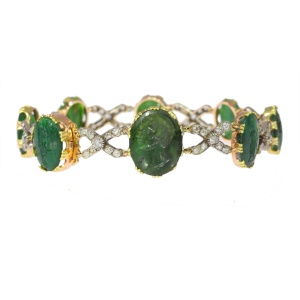
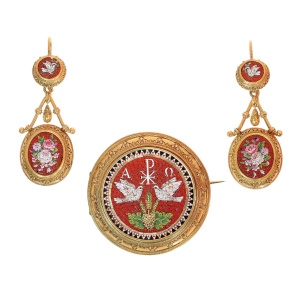
In Rome, workshops produced micromosaic brooches and pendants depicting classical ruins and mythological scenes. In France, some nineteenth century jewellers incorporated classical motifs into enamelled pieces which combined historical reference with contemporary design. Britain contributed through firms specialising in classical cameos, intaglios and hardstone carvings, while many such carvings were purchased in Italy as Grand Tour souvenirs and later mounted or retailed elsewhere.
Typical examples include gold earrings with granulated discs, Greek Revival bracelets with enamelled palmettes, Roman inspired micromosaic brooches, and Egyptian Revival pendants featuring stylised wings or lotus forms.
6. Recognition in Practice
Archaeological Revival jewellery is recognisable by its deliberate reference to ancient Mediterranean cultures. Etruscan Revival pieces favour high carat gold with matte surfaces, enriched by granulation and filigree arranged in precise patterns. Greek Revival designs use classical palmettes, anthemion, meanders and cameos that echo the harmony of ancient art. Roman Revival and Grand Tour jewellery often incorporates micromosaics and hardstone intaglios. Coral and lava were also popular in Italian souvenir jewellery and were sometimes set in classical themed pieces. Egyptian Revival pieces adopt lotus forms, winged symbols and stylised motifs inspired by Pharaonic ornament.
These pieces prioritise structural clarity and historically informed detail. Compared with genuine antiquities, nineteenth century revivals tend to be larger, more regular in execution, and adapted to contemporary jewellery formats. They reflect both admiration for ancient art and nineteenth century aesthetic priorities.
7. Related Styles and Legacy
Archaeological Revival jewellery forms a key chapter in the nineteenth century historicism. It intersects with Historic Revival styles which draw on medieval and Renaissance sources, yet remains distinct in its focus on antiquity and technical reconstruction.
Some of its emphasis on handwork, material integrity and structural clarity resonates with later movements, including Arts and Crafts. Egyptian Revival motifs reappeared dramatically in the 1920s, especially after the 1922 discovery of Tutankhamun's tomb, linking nineteenth century revivalism to Art Deco design. Today, Archaeological Revival jewels are valued for their craftsmanship and the insight they provide into nineteenth century interpretations of the ancient world.
8. Purpose of This Page
This page offers an overview of the historical Archaeological Revival jewellery style within the context of jewellery history and design. It focuses on what is relevant from the perspective of the jewellery world and does not aim to be a full encyclopaedia on the Archaeological Revival jewellery style. Instead, it strives to offer a concise and structured introduction that outlines key interpretive angles and points towards deeper study. This page is part of the Adin Glossary, a curated resource that brings documented historical knowledge into an ordered and accessible structure. Use and sharing for educational purposes are welcomed, and readers who reference or quote this page are kindly asked to mention Adin as their source.
9. Accuracy Note
Every effort has been made to present this information accurately and in line with current historical understanding. Interpretations may evolve as new research becomes available, and readers who notice points for refinement are welcome to share their insights.
10. Author Attribution
Elkan Wijnberg, Jewellery Historian and Antique Jewellery Specialist – Adin – www.antiquejewel.com