
Adin Glossary: Styles and periods

Austro Hungarian Historicist jewellery

circa 1867 to 1918, Gothic and Baroque mix, cartouches, stones

1. Introduction

Austro Hungarian Historicist jewellery developed in the late nineteenth century within the multiethnic Austro Hungarian Empire, as jewellers revived Gothic, Renaissance and Baroque sources alongside local workshop traditions. The result is richly ornamented goldwork, often with enamel and small gemstones, in which historical reference remains disciplined by careful composition and technical precision.

2. Historical and Cultural Context

Across Central Europe, renewed interest in historical styles and the academic study of art history encouraged patrons to favour jewellery that referenced several past periods at once. In the Austro Hungarian Empire, this taste intersected with regional identity and strong urban workshop cultures, producing pieces prized for both historical awareness and craftsmanship.

3. Visual Characteristics and Materials

Designs integrate multiple historical vocabularies within a single composition, commonly combining Gothic arches and tracery, Renaissance scrolls, Baroque cartouches and neoclassical frames or laurel elements, often arranged symmetrically. Heraldic shields, monograms, enamelled plaques, medallions and locket forms can appear within these architectural, carefully balanced layouts.

Gold, typically high carat, is the principal metal, sometimes combined with silver. Coloured enamel and small faceted gemstones are common, with seed pearls and occasional glass pastes in some ranges. Fine chasing and engraving, repoussé, applied ornament, pierced openwork and enamel painting create dense surface detail, often paired with careful finishing on the reverse and edges.

4. Function and Meaning

Meaning is carried by the choice and combination of historical motifs, which can signal cultural heritage and educated taste. Personal devices, such as initials, monograms, miniature portraits or lockets, add private significance.

Pieces were produced for an expanding bourgeois clientele in Vienna, Budapest and Prague, and could express identity and taste within a socially diverse empire. At the same time it is important to remember that perhaps most Austro Hungarian Historicist jewels were created and worn simply because their materials, colours or forms appealed, without any further intention than beauty and attraction.

5. Notable Creators and Exemplary Pieces

Production was centred in skilled workshops in Vienna, Budapest and Prague, and pieces are more often identified through maker’s marks than through widely recognised names. Typical survivals include brooches combining Gothic, Renaissance and Baroque motifs, lockets with miniature portraits, sometimes incorporating hairwork, and pendants integrating enamel with small gemstones.

6. Recognition in Practice

Look for disciplined compositions that deliberately mix historical motifs, for example Gothic tracery beside Renaissance scrollwork and Baroque cartouches, often framed by neoclassical elements and arranged symmetrically. Workmanship is typically meticulous, with fine chasing or engraving and frequent openwork, and the overall effect is richly decorative yet coherent and carefully proportioned.

7. Legacy and Related Styles

The style overlaps with broader nineteenth century revival currents, including French revival taste, Biedermeier and Eclecticism, yet remains a distinct Central European interpretation shaped by Austro Hungarian workshop traditions. Its legacy is visible in continued regional historicist and revivalist jewellery into the early twentieth century, showing how historical reference could be balanced with technical mastery and coherent design.

8. Purpose of This Page

This page offers an overview of the historical Austro Hungarian Historicist jewellery style within the context of jewellery history and design. It focuses on what is relevant from the perspective of the jewellery world and does not aim to be a full encyclopaedia on the Austro Hungarian Historicist jewellery style. Instead, it strives to offer a concise and structured introduction that outlines key interpretive angles and points towards deeper study. This page is part of the Adin Glossary, a curated resource that brings documented historical knowledge into an ordered and accessible structure. Use and sharing for educational purposes are welcomed, and readers who reference or quote this page are kindly asked to mention Adin as their source.

9. Accuracy Note

Every effort has been made to present this information accurately and in line with current historical understanding. Interpretations may evolve as new research becomes available, and readers who notice points for refinement are welcome to share their insights.

10. Author Attribution

Elkan Wijnberg, Jewellery Historian and Antique Jewellery Specialist – Adin – www.antiquejewel.com
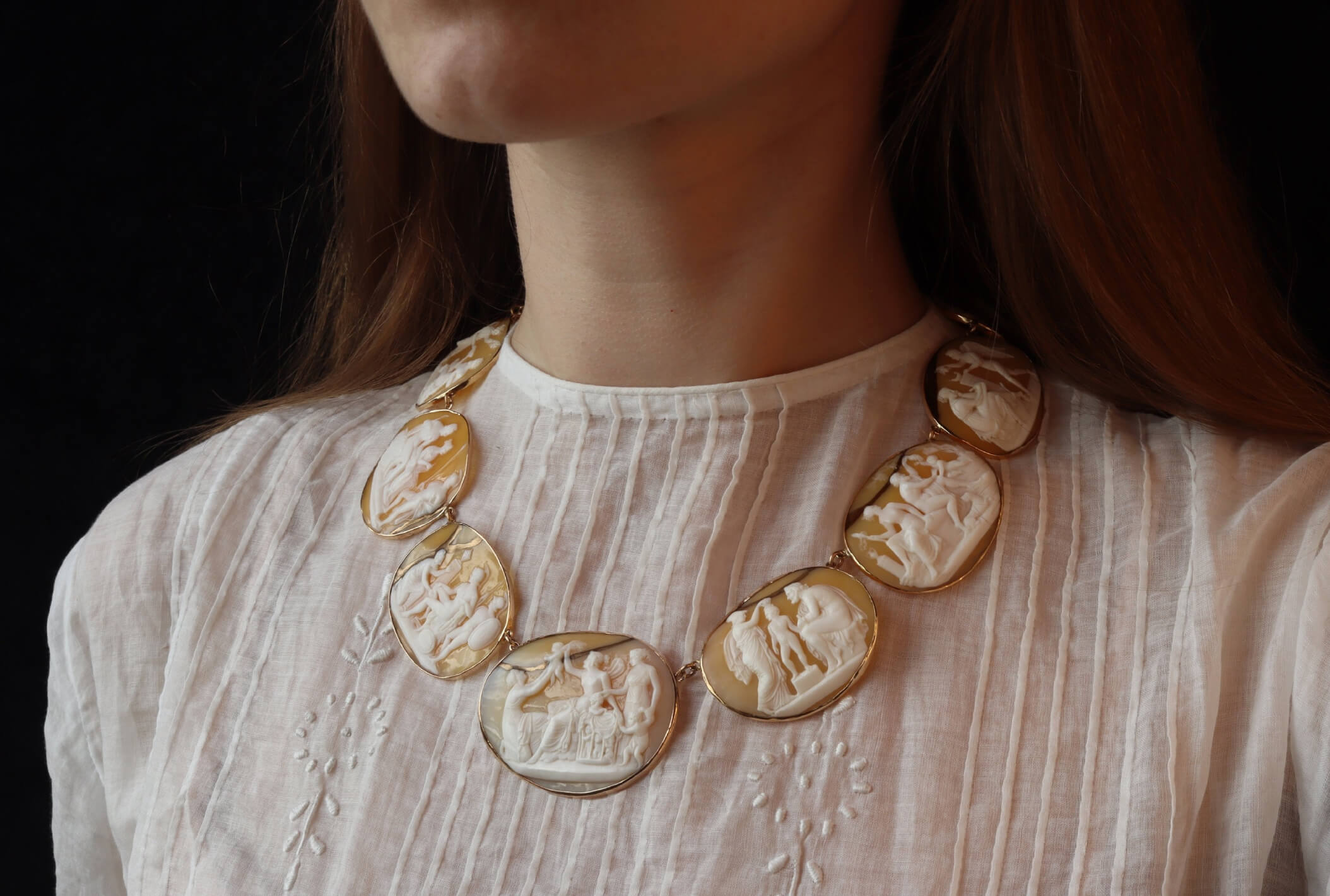
Enamelled plaques, medallions and locket forms, finished with chased detail, openwork edges and seed pearls or faceted gems.

circa 1867 to 1918

Central European historicism, Austro Hungarian Empire, Gothic revival, Renaissance revival, Baroque revival, neoclassical ornament, French revival taste, Biedermeier tradition, Eclecticism, academic art history, urban workshops in Vienna, Budapest and Prague, bourgeois patronage

Austria, Hungary, Czech Republic

Gothic arches and tracery, Renaissance scrolls and volutes, Baroque cartouches, neoclassical frames and laurel elements, architectural panels, miniature portrait lockets, monograms and initials, heraldic shields, enamelled plaques, medallions with historical or allegorical imagery

high carat gold as principal metal, gold combined with silver, enamel (often coloured), small faceted gemstones, seed pearls, glass pastes in some ranges

fine chasing and engraving, repoussé work, openwork and pierced metal, applied ornament, painted enamel on metal, construction of lockets and hinged compartments, detailed finishing on reverse and edges

Historicism, Eclecticism, Byzantine, Renaissance, Baroque

Historicism, Revivals & Eclectic Mix (looking back + recombining)

Adin Academy

Austro Hungarian Historicist jewellery

No items found.

1. Introduction

Austro Hungarian Historicist jewellery developed in the late nineteenth century within the multiethnic Austro Hungarian Empire, as jewellers revived Gothic, Renaissance and Baroque sources alongside local workshop traditions. The result is richly ornamented goldwork, often with enamel and small gemstones, in which historical reference remains disciplined by careful composition and technical precision.

2. Historical and Cultural Context

Across Central Europe, renewed interest in historical styles and the academic study of art history encouraged patrons to favour jewellery that referenced several past periods at once. In the Austro Hungarian Empire, this taste intersected with regional identity and strong urban workshop cultures, producing pieces prized for both historical awareness and craftsmanship.

3. Visual Characteristics and Materials

Designs integrate multiple historical vocabularies within a single composition, commonly combining Gothic arches and tracery, Renaissance scrolls, Baroque cartouches and neoclassical frames or laurel elements, often arranged symmetrically. Heraldic shields, monograms, enamelled plaques, medallions and locket forms can appear within these architectural, carefully balanced layouts.

Gold, typically high carat, is the principal metal, sometimes combined with silver. Coloured enamel and small faceted gemstones are common, with seed pearls and occasional glass pastes in some ranges. Fine chasing and engraving, repoussé, applied ornament, pierced openwork and enamel painting create dense surface detail, often paired with careful finishing on the reverse and edges.

4. Function and Meaning

Meaning is carried by the choice and combination of historical motifs, which can signal cultural heritage and educated taste. Personal devices, such as initials, monograms, miniature portraits or lockets, add private significance.

Pieces were produced for an expanding bourgeois clientele in Vienna, Budapest and Prague, and could express identity and taste within a socially diverse empire. At the same time it is important to remember that perhaps most Austro Hungarian Historicist jewels were created and worn simply because their materials, colours or forms appealed, without any further intention than beauty and attraction.

5. Notable Creators and Exemplary Pieces

Production was centred in skilled workshops in Vienna, Budapest and Prague, and pieces are more often identified through maker’s marks than through widely recognised names. Typical survivals include brooches combining Gothic, Renaissance and Baroque motifs, lockets with miniature portraits, sometimes incorporating hairwork, and pendants integrating enamel with small gemstones.

6. Recognition in Practice

Look for disciplined compositions that deliberately mix historical motifs, for example Gothic tracery beside Renaissance scrollwork and Baroque cartouches, often framed by neoclassical elements and arranged symmetrically. Workmanship is typically meticulous, with fine chasing or engraving and frequent openwork, and the overall effect is richly decorative yet coherent and carefully proportioned.

7. Legacy and Related Styles

The style overlaps with broader nineteenth century revival currents, including French revival taste, Biedermeier and Eclecticism, yet remains a distinct Central European interpretation shaped by Austro Hungarian workshop traditions. Its legacy is visible in continued regional historicist and revivalist jewellery into the early twentieth century, showing how historical reference could be balanced with technical mastery and coherent design.

8. Purpose of This Page

This page offers an overview of the historical Austro Hungarian Historicist jewellery style within the context of jewellery history and design. It focuses on what is relevant from the perspective of the jewellery world and does not aim to be a full encyclopaedia on the Austro Hungarian Historicist jewellery style. Instead, it strives to offer a concise and structured introduction that outlines key interpretive angles and points towards deeper study. This page is part of the Adin Glossary, a curated resource that brings documented historical knowledge into an ordered and accessible structure. Use and sharing for educational purposes are welcomed, and readers who reference or quote this page are kindly asked to mention Adin as their source.

9. Accuracy Note

Every effort has been made to present this information accurately and in line with current historical understanding. Interpretations may evolve as new research becomes available, and readers who notice points for refinement are welcome to share their insights.

10. Author Attribution

Elkan Wijnberg, Jewellery Historian and Antique Jewellery Specialist – Adin – www.antiquejewel.com
Also known as:

References