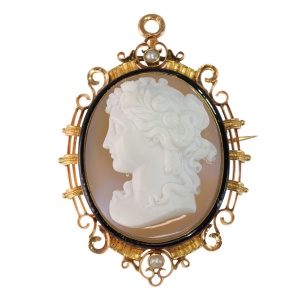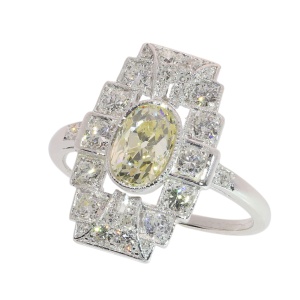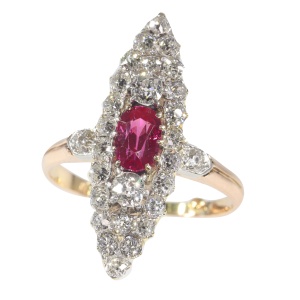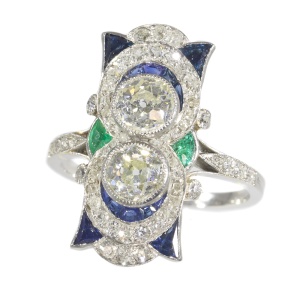

A style of setting a gemstone in a finger ring in which there is metal under the stone so that no part of the stone below the gridle is exposed to light; the stone was set in a collet soldered to thehoop of the ring.This was the style of early ring settings and often the jeweller used foil or paint on the unexposed back of the stone to enhance its appearance.The style was used in the Renaissance, before the importance of the gemstone itself was appreciated, and the bezel received lavish decoration. It was superseded in the 18th century by thecut-down setting, but to greater extent in the 19th century by the use of a collet made of a thin band and the development of the claw setting, the millegrain setting, and later variations.Sometimes a small hole is bored in the base of a closed setting for transparent stones so that they can be cleaned.
Closed Setting

Closed Setting
A style of setting a gemstone in a finger ring in which there is metal under the stone so that no part of the stone below the gridle is exposed to light; the stone was set in a collet soldered to thehoop of the ring.This was the style of early ring settings and often the jeweller used foil or paint on the unexposed back of the stone to enhance its appearance.The style was used in the Renaissance, before the importance of the gemstone itself was appreciated, and the bezel received lavish decoration. It was superseded in the 18th century by thecut-down setting, but to greater extent in the 19th century by the use of a collet made of a thin band and the development of the claw setting, the millegrain setting, and later variations.Sometimes a small hole is bored in the base of a closed setting for transparent stones so that they can be cleaned.
References
From: An Illustrated Dictionary of Jewelry, autor: Harold Newman, publishers: Thames and Hudson