
Corundum

This glossary entry has not yet been updated and is under review.
Corundum

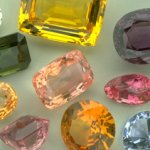
See our:blue corundum jewelry (sapphire) orred corundum jewelry (ruby).A mineral (aluminium oxide) that is the hardest mineral other than the diamond; its hardness on the Mohs scale is 9. It is found in two varieties:common corundum, which is impure, coarse, opaque and granular (known as emery), and used as an abrasivetransparent corundum, which includes the ruby and the sapphire (both identical except as to color)Corundum (seldom colorless) exhibits a wide range of colors (blue, pink, green, yellow, etc.) and such stones are properly termed sapphires preceded by the appropriate color (designations usingthe names of other similar-appearing stones preceded by the word 'Oriental' being misnomers), except that the red variety is called 'ruby'. The colors in some cases are probably due to traces ofmetallic oxides.The cut specimens are characterized by their vitreous luster high specific gravity, weak color dispersion, double refraction and, when colored, dichroism, which enable them to be distinguishedfrom other varieties of stones of similar appearance, as does microscopic examination.Some specimens show a sheen (silk) and some have an interior series of minute, needle-like inclusions (feathers) of rutile; these, when properly cut en cabochon, are star rubies and star sapphiresor, when having only one ray of light, 'corundum cat's-eye'. Multicolored stones are common, and patches of two colors are sometimes found in a stone and show an apparent blended tint.Corundum stones are cut as table cut, step cut, brilliant cut, and mixed cut.
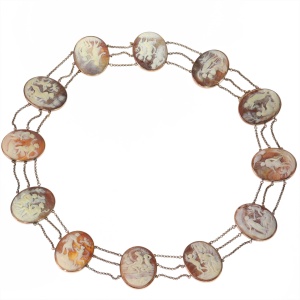
Explanation on corundum by Adin antique vintage and estate jewelry
Adin Academy

Corundum

No items found.
Corundum

See our:blue corundum jewelry (sapphire) orred corundum jewelry (ruby).A mineral (aluminium oxide) that is the hardest mineral other than the diamond; its hardness on the Mohs scale is 9. It is found in two varieties:common corundum, which is impure, coarse, opaque and granular (known as emery), and used as an abrasivetransparent corundum, which includes the ruby and the sapphire (both identical except as to color)Corundum (seldom colorless) exhibits a wide range of colors (blue, pink, green, yellow, etc.) and such stones are properly termed sapphires preceded by the appropriate color (designations usingthe names of other similar-appearing stones preceded by the word 'Oriental' being misnomers), except that the red variety is called 'ruby'. The colors in some cases are probably due to traces ofmetallic oxides.The cut specimens are characterized by their vitreous luster high specific gravity, weak color dispersion, double refraction and, when colored, dichroism, which enable them to be distinguishedfrom other varieties of stones of similar appearance, as does microscopic examination.Some specimens show a sheen (silk) and some have an interior series of minute, needle-like inclusions (feathers) of rutile; these, when properly cut en cabochon, are star rubies and star sapphiresor, when having only one ray of light, 'corundum cat's-eye'. Multicolored stones are common, and patches of two colors are sometimes found in a stone and show an apparent blended tint.Corundum stones are cut as table cut, step cut, brilliant cut, and mixed cut.
Also known as:

References

From: An Illustrated Dictionary of Jewelry, autor: Harold Newman, publishers: Thames and Hudson