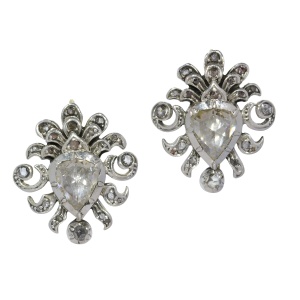

See our: earrings studs.A type of ear ornament composed of a front and a rear part joined by shanks of tubular form (one larger than the other) that fit through the ear-lobe and connect in a telescopic manner. When worn, only the front part is seen, and it is sometimes boss-shaped and decorated, while the rear part is flat and undecorated.Examples are recorded in Egyptian jewelry near the end of the reign of Amenhotep II (1410 BC -1374 BC). Sometimes an elaborate ornament was suspended from the shank, as on a pair in the Tutankhamun jewelry. Examples in Etruscan jewelry are in the form of a disc with a rear projection for insertion in the ear-lobe. It has been suggested, on account of the very large shanks, that some examples may not have been ear ornaments but possibly a type of dress fastener.
Ear-Stud
Ear-Stud
See our: earrings studs.A type of ear ornament composed of a front and a rear part joined by shanks of tubular form (one larger than the other) that fit through the ear-lobe and connect in a telescopic manner. When worn, only the front part is seen, and it is sometimes boss-shaped and decorated, while the rear part is flat and undecorated.Examples are recorded in Egyptian jewelry near the end of the reign of Amenhotep II (1410 BC -1374 BC). Sometimes an elaborate ornament was suspended from the shank, as on a pair in the Tutankhamun jewelry. Examples in Etruscan jewelry are in the form of a disc with a rear projection for insertion in the ear-lobe. It has been suggested, on account of the very large shanks, that some examples may not have been ear ornaments but possibly a type of dress fastener.
References
From: An Illustrated Dictionary of Jewelry, autor: Harold Newman, publishers: Thames and Hudson