
Adin Glossary: Styles and periods

Egyptian Revival jewellery (Tutankhamun phase)

ca. 1922 to early 1930s, Art Deco geometry, scarabs, lotus, calibré colour

1. Introduction

The Tutankhamun phase of Egyptian Revival jewellery developed in the 1920s and early 1930s following the 1922 discovery of Tutankhamun’s tomb, which drew widespread public interest and extensive media coverage.

Designers incorporated Egyptian motifs into the geometric language of Art Deco, combining ancient imagery with modern materials and clearly structured forms.

This phase was commercially popular, with Egyptian imagery used mainly as a thematic influence within Art Deco design rather than an independent stylistic system.

2. Cultural and Historical Influences

The 1922 discovery of the tomb of Tutankhamun by Howard Carter and his team (working for the Earl of Carnarvon), and its extensive media coverage, made Egyptian imagery newly familiar to a broad public. Museums, illustrated publications, photographs, public lectures and exhibitions about ancient Egypt reinforced this fascination and helped circulate these motifs beyond specialist circles.

Art Deco design, with its emphasis on geometric structure, modern materials and stylisation, provided a framework that Egyptian motifs could be absorbed. The result reflects archaeological enthusiasm as well as a wider cultural shift towards modernity in the early twentieth century.

3. Visual Characteristics and Materials

Jewellery of the Tutankhamun phase combines Egyptian motifs with the geometric clarity of Art Deco. Forms are structured and symmetrical, built from straight lines, stepped shapes and colour contrasts. Onyx, turquoise, coral, lapis and coloured glass frequently appear as calibrated elements, set alongside precious stones to create crisp, controlled colour panels.

Falcons, scarabs, lotus flowers and sun discs are reduced to sharp outlines that fit modern composition. The overall rhythm remains Art Deco, with Egyptian imagery serving as a thematic accent within a disciplined geometric layout.

4. Function and Meaning

In this phase, Egyptian motifs were typically interpreted through the aesthetic values of the Art Deco period, and for many wearers they functioned more as fashionable references to antiquity than as statements of ancient Egyptian religion. Falcons, scarabs and sun discs could be read as signs of archaeological discovery, engagement with world cultures and visual sophistication. At the same time it is important to remember that perhaps most Egyptian Revival jewellery (Tutankhamun phase) jewels were created and worn simply because their materials, colours or forms appealed, without any further intention than beauty and attraction.

Their meaning reflected contemporary interest in exploration, museum culture and modern design, rather than a rigorous attempt to reproduce the original context of those forms. Within Art Deco jewellery, these motifs served as stylised references to antiquity, supporting compositions that emphasised geometry, clarity and controlled colour contrasts.

5. Notable Creators and Exemplary Pieces

Egyptian Revival jewellery of the Tutankhamun phase was produced by major maisons and smaller workshops within the Art Deco movement. Leading houses occasionally incorporated Egyptian motifs into geometric designs, while independent ateliers produced pieces aligned with the wider fashion for stylised antiquity.

Examples include brooches with sharp winged forms, pendants with simplified falcons or scarabs, and bracelets combining calibrated colour arrangements with structured settings. Hardstones, glass and enamel were often used to achieve the contrasts favoured in Art Deco jewellery.

6. How to Recognise the Style

Look for Art Deco geometry combined with stylised Egyptian motifs: straight lines, stepped outlines and controlled symmetry framing simplified scarabs, falcons, lotus flowers and sun discs. Colour is often organised into calibrated panels, using onyx, turquoise, coral, lapis or coloured glass to create sharp contrasts within a precise, modern layout.

7. Related Styles and Legacy

The Tutankhamun phase is best understood as an Art Deco related current rather than an independent style. It follows the earlier Napoleonic revival, which placed Egyptian motifs within a neoclassical framework, as well as the late nineteenth century revival associated with the 1869 opening of the Suez Canal.

In the 1920s, Egyptian imagery was adapted to modern geometry and controlled colour contrasts, and these stylised references to ancient Egypt recurred in later twentieth century jewellery.

8. Purpose of This Page

This page offers an overview of the historical Egyptian Revival jewellery (Tutankhamun phase) style within the context of jewellery history and design. It focuses on what is relevant from the perspective of the jewellery world and does not aim to be a full encyclopaedia on the Egyptian Revival jewellery (Tutankhamun phase) style. Instead, it strives to offer a concise and structured introduction that outlines key interpretive angles and points towards deeper study. This page is part of the Adin Glossary, a curated resource that brings documented historical knowledge into an ordered and accessible structure. Use and sharing for educational purposes are welcomed, and readers who reference or quote this page are kindly asked to mention Adin as their source.

9. Accuracy Note

Every effort has been made to present this information accurately and in line with current historical understanding. Interpretations may evolve as new research becomes available, and readers who notice points for refinement are welcome to share their insights.

10. Author Attribution

Elkan Wijnberg, Jewellery Historian and Antique Jewellery Specialist – Adin – www.antiquejewel.com
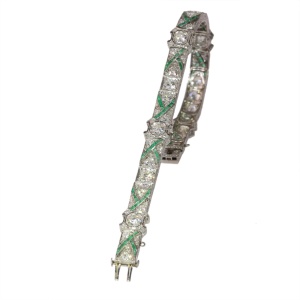
Art Deco symmetry with Egyptian accents, stepped outlines, scarabs and falcons, calibré panels of onyx, turquoise, coral or lapis for sharp contrast.

circa 1922 to early 1930s

discovery of the tomb of Tutankhamun (1922), Art Deco geometry, interwar modernity, museum culture, public lectures and exhibitions about ancient Egypt, media coverage of Egyptology, archaeological enthusiasm, interest in world cultures, fashion for stylised antiquity

stylised scarabs, falcons and hawks, lotus flowers, sun discs, winged forms, stepped and rectilinear frames, geometric borders with Egyptian accents, calibrated colour panels in onyx, turquoise, coral, lapis and coloured glass

platinum and white gold mounts, onyx, turquoise, coral, lapis lazuli, coloured glass, diamonds and other calibrated gemstones, enamel used for flat colour contrasts

calibré cut gemstones set in channels, pavé diamond work within geometric layouts, stepped and rectilinear construction, inlay and panelled colour arrangements, precise metalwork aligning Egyptian motifs with Art Deco symmetry

Art Deco, Interbellum, Archaeological Revival, Egyptian Revival (Suez Canal), Egyptian Revival (Napoleon)

Exoticism & Cross-Cultural Borrowing (importing motifs and a ‘foreign’ vocabulary)

Adin Academy

Egyptian Revival jewellery (Tutankhamun phase)

No items found.

1. Introduction

The Tutankhamun phase of Egyptian Revival jewellery developed in the 1920s and early 1930s following the 1922 discovery of Tutankhamun’s tomb, which drew widespread public interest and extensive media coverage.

Designers incorporated Egyptian motifs into the geometric language of Art Deco, combining ancient imagery with modern materials and clearly structured forms.

This phase was commercially popular, with Egyptian imagery used mainly as a thematic influence within Art Deco design rather than an independent stylistic system.

2. Cultural and Historical Influences

The 1922 discovery of the tomb of Tutankhamun by Howard Carter and his team (working for the Earl of Carnarvon), and its extensive media coverage, made Egyptian imagery newly familiar to a broad public. Museums, illustrated publications, photographs, public lectures and exhibitions about ancient Egypt reinforced this fascination and helped circulate these motifs beyond specialist circles.

Art Deco design, with its emphasis on geometric structure, modern materials and stylisation, provided a framework that Egyptian motifs could be absorbed. The result reflects archaeological enthusiasm as well as a wider cultural shift towards modernity in the early twentieth century.

3. Visual Characteristics and Materials

Jewellery of the Tutankhamun phase combines Egyptian motifs with the geometric clarity of Art Deco. Forms are structured and symmetrical, built from straight lines, stepped shapes and colour contrasts. Onyx, turquoise, coral, lapis and coloured glass frequently appear as calibrated elements, set alongside precious stones to create crisp, controlled colour panels.

Falcons, scarabs, lotus flowers and sun discs are reduced to sharp outlines that fit modern composition. The overall rhythm remains Art Deco, with Egyptian imagery serving as a thematic accent within a disciplined geometric layout.

4. Function and Meaning

In this phase, Egyptian motifs were typically interpreted through the aesthetic values of the Art Deco period, and for many wearers they functioned more as fashionable references to antiquity than as statements of ancient Egyptian religion. Falcons, scarabs and sun discs could be read as signs of archaeological discovery, engagement with world cultures and visual sophistication. At the same time it is important to remember that perhaps most Egyptian Revival jewellery (Tutankhamun phase) jewels were created and worn simply because their materials, colours or forms appealed, without any further intention than beauty and attraction.

Their meaning reflected contemporary interest in exploration, museum culture and modern design, rather than a rigorous attempt to reproduce the original context of those forms. Within Art Deco jewellery, these motifs served as stylised references to antiquity, supporting compositions that emphasised geometry, clarity and controlled colour contrasts.

5. Notable Creators and Exemplary Pieces

Egyptian Revival jewellery of the Tutankhamun phase was produced by major maisons and smaller workshops within the Art Deco movement. Leading houses occasionally incorporated Egyptian motifs into geometric designs, while independent ateliers produced pieces aligned with the wider fashion for stylised antiquity.

Examples include brooches with sharp winged forms, pendants with simplified falcons or scarabs, and bracelets combining calibrated colour arrangements with structured settings. Hardstones, glass and enamel were often used to achieve the contrasts favoured in Art Deco jewellery.

6. How to Recognise the Style

Look for Art Deco geometry combined with stylised Egyptian motifs: straight lines, stepped outlines and controlled symmetry framing simplified scarabs, falcons, lotus flowers and sun discs. Colour is often organised into calibrated panels, using onyx, turquoise, coral, lapis or coloured glass to create sharp contrasts within a precise, modern layout.

7. Related Styles and Legacy

The Tutankhamun phase is best understood as an Art Deco related current rather than an independent style. It follows the earlier Napoleonic revival, which placed Egyptian motifs within a neoclassical framework, as well as the late nineteenth century revival associated with the 1869 opening of the Suez Canal.

In the 1920s, Egyptian imagery was adapted to modern geometry and controlled colour contrasts, and these stylised references to ancient Egypt recurred in later twentieth century jewellery.

8. Purpose of This Page

This page offers an overview of the historical Egyptian Revival jewellery (Tutankhamun phase) style within the context of jewellery history and design. It focuses on what is relevant from the perspective of the jewellery world and does not aim to be a full encyclopaedia on the Egyptian Revival jewellery (Tutankhamun phase) style. Instead, it strives to offer a concise and structured introduction that outlines key interpretive angles and points towards deeper study. This page is part of the Adin Glossary, a curated resource that brings documented historical knowledge into an ordered and accessible structure. Use and sharing for educational purposes are welcomed, and readers who reference or quote this page are kindly asked to mention Adin as their source.

9. Accuracy Note

Every effort has been made to present this information accurately and in line with current historical understanding. Interpretations may evolve as new research becomes available, and readers who notice points for refinement are welcome to share their insights.

10. Author Attribution

Elkan Wijnberg, Jewellery Historian and Antique Jewellery Specialist – Adin – www.antiquejewel.com
Also known as:

References