
Adin Glossary: Styles and periods

Greco Roman jewellery

circa 500 BCE to 300 CE, laurel, acanthus, palmettes, intaglios, goldwork

1. Introduction

The Greco Roman style covers the artistic traditions of ancient Greece and Rome from the Classical Greek period through the Roman Imperial period, broadly to the third century CE.

It is often characterised by symmetry, proportion and balanced composition, expressed through geometric order, refined ornament and naturalistic figures. Its forms and techniques formed a foundation for the classical vocabulary that later European design repeatedly revisited.

2. Cultural and Historical Influences

The Greco Roman style developed within a shared Mediterranean world shaped by the exchange of ideas between Greek and Roman societies. Greek art provided many models of proportion, naturalism and ornament that later shaped Roman production.

As the Roman Empire expanded, these classical forms spread across the Mediterranean and were adapted to local traditions. Workshops shared techniques, imagery and materials, creating a broadly unified visual vocabulary that remained influential long after antiquity.

3. Visual Characteristics and Materials

Greco Roman design favours balanced proportions, clear geometry and refined naturalism. Ornament includes wreaths, palmettes and acanthus leaves alongside idealised figures, rendered with controlled detail and harmonious outlines. Greek influence appears in the emphasis on symmetry and restrained ornament, while Roman production often favoured broader decorative schemes and placed particular emphasis on portraiture, especially in imperial contexts.

High purity gold dominates surviving pieces, and silver is also well attested although it survives less often, often combined with engraved gemstones, coloured stones or glass inlays. Surfaces are smooth and carefully modelled, with fine engraving used to define details.

Technical skill is especially evident in goldworking and gem engraving. Hellenistic workshops developed complex articulated constructions, while Roman craftsmen expanded portrait engravings and intaglios carved with mythological or portrait subjects.

4. Function and Meaning

Symbolism and Meaning

Symbolism in the Greco Roman world reflected civic identity, mythology and ideals of virtue rather than later religious associations. Laurel wreaths signified honour and achievement, while acanthus and palmette motifs functioned primarily as classical foliage ornament, and any symbolic associations were broad rather than fixed. At the same time it is important to remember that perhaps most Greco Roman jewels were created and worn simply because their materials, colours or forms appealed, without any further intention than beauty and attraction.

Mythological figures represented moral values, heroic narratives or protective themes drawn from classical stories. Portraits and inscriptions conveyed status and personal identity, and jewellery operated within a wider framework in which art served both public and private functions in a structured civic environment.

5. Notable Creators and Exemplary Pieces

Most Greco Roman jewellery was produced in workshops whose individual makers are rarely recorded.

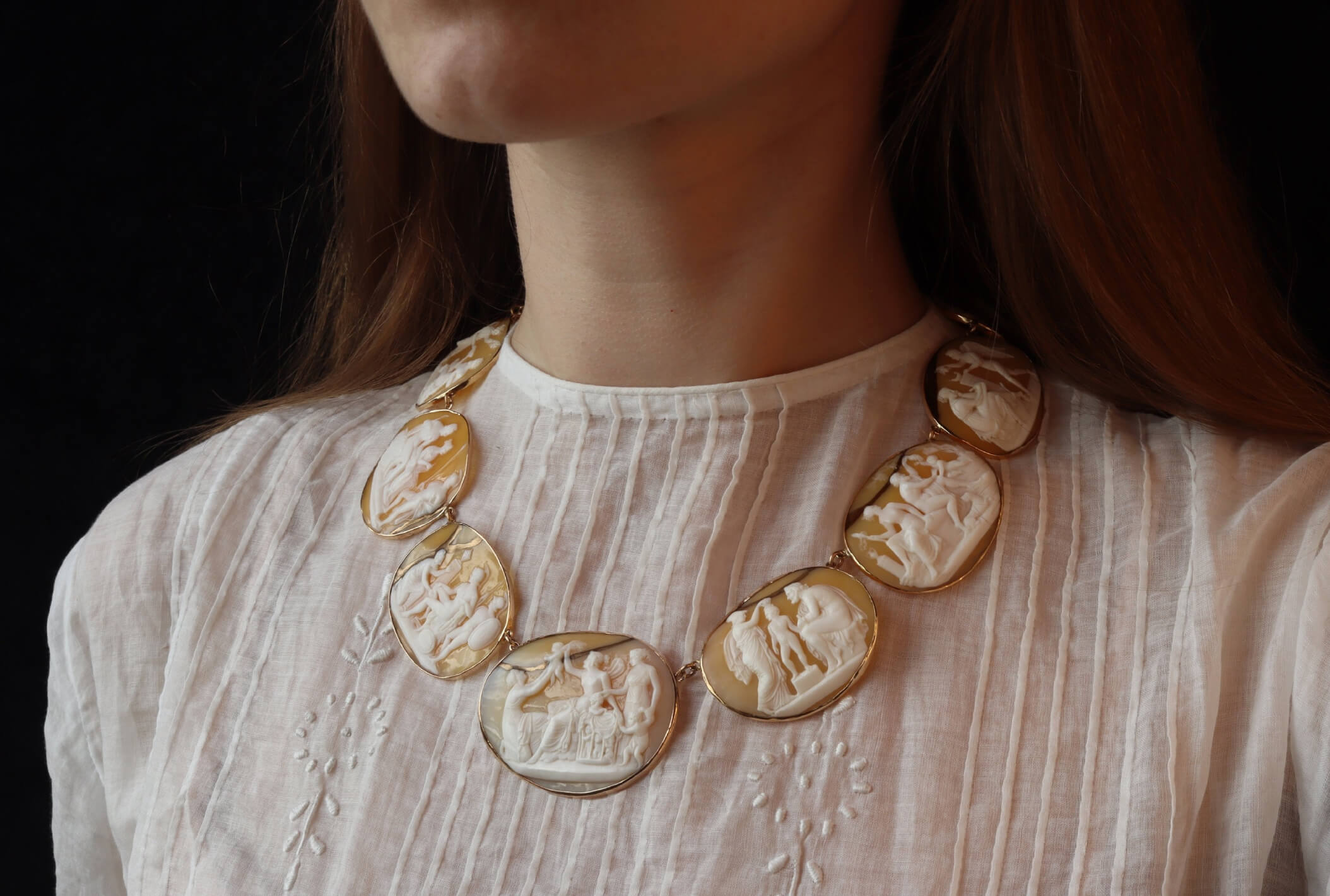
Typical pieces include intaglio rings carved with mythological scenes, earrings with balanced geometric forms and pendants decorated with acanthus or laurel motifs. They show the precision and aesthetic discipline that defined classical craftsmanship.

6. How to Recognise the Style

Greco Roman pieces are recognisable by their balanced proportions, clear geometry and refined naturalism. Motifs such as laurel wreaths, acanthus leaves, palmettes and idealised figures appear with controlled, harmonious outlines.

Settings are often relatively simple, following the form of the stone or motif rather than imposing complex structures. The impression is one of clarity, proportion and classical order.

7. Related Styles and Legacy

Legacy

The Greco Roman style forms a foundation for the classical tradition in Western art and has influenced many later periods. It became a reference point for designers throughout European history.

Later reinterpretations and related styles

Its principles of proportion, clarity and balanced composition were revived during the Renaissance and again in the eighteenth and nineteenth centuries in Neoclassicism and various archaeological movements. These later styles drew on classical sources but reinterpreted them according to the values of their own time. The original Greco Roman style remains defined by its ancient context and the cultural and artistic exchanges between Greek and Roman societies that shaped the classical world.

8. Purpose of This Page

This page offers an overview of the historical Greco Roman jewellery style within the context of jewellery history and design. It focuses on what is relevant from the perspective of the jewellery world and does not aim to be a full encyclopaedia on the Greco Roman jewellery style. Instead, it strives to offer a concise and structured introduction that outlines key interpretive angles and points towards deeper study. This page is part of the Adin Glossary, a curated resource that brings documented historical knowledge into an ordered and accessible structure. Use and sharing for educational purposes are welcomed, and readers who reference or quote this page are kindly asked to mention Adin as their source.

9. Accuracy Note

Every effort has been made to present this information accurately and in line with current historical understanding. Interpretations may evolve as new research becomes available, and readers who notice points for refinement are welcome to share their insights.

10. Author Attribution

Elkan Wijnberg, Jewellery Historian and Antique Jewellery Specialist – Adin – www.antiquejewel.com
Classical jewellery of balanced proportion, laurel and acanthus ornament, smooth high purity gold, with intaglio rings and disciplined geometric borde

circa 500 BCE to 300 CE

Greek classical art, Hellenistic goldworking, Roman imperial culture, civic and public life in antiquity, classical mythology, philosophical ideals of harmony and proportion, Mediterranean trade and cultural exchange

Greece, Italy

laurel wreaths, palmettes, acanthus leaves, idealised human figures, mythological scenes, geometric borders, classical scrolls, portrait intaglios, wreaths and garlands, architectural friezes

high purity gold, silver, engraved gemstones, coloured stones, glass inlays

precise goldworking, gem engraving including intaglio carving, fine engraving, careful modelling, articulated constructions

Greek, Classical, Neoclassicism, Directoire, Empire, Archaeological Revival

Classical & Antiquarian Classicism (ancient formal language as the core)

Adin Academy

Greco Roman jewellery

No items found.

1. Introduction

The Greco Roman style covers the artistic traditions of ancient Greece and Rome from the Classical Greek period through the Roman Imperial period, broadly to the third century CE.

It is often characterised by symmetry, proportion and balanced composition, expressed through geometric order, refined ornament and naturalistic figures. Its forms and techniques formed a foundation for the classical vocabulary that later European design repeatedly revisited.

2. Cultural and Historical Influences

The Greco Roman style developed within a shared Mediterranean world shaped by the exchange of ideas between Greek and Roman societies. Greek art provided many models of proportion, naturalism and ornament that later shaped Roman production.

As the Roman Empire expanded, these classical forms spread across the Mediterranean and were adapted to local traditions. Workshops shared techniques, imagery and materials, creating a broadly unified visual vocabulary that remained influential long after antiquity.

3. Visual Characteristics and Materials

Greco Roman design favours balanced proportions, clear geometry and refined naturalism. Ornament includes wreaths, palmettes and acanthus leaves alongside idealised figures, rendered with controlled detail and harmonious outlines. Greek influence appears in the emphasis on symmetry and restrained ornament, while Roman production often favoured broader decorative schemes and placed particular emphasis on portraiture, especially in imperial contexts.

High purity gold dominates surviving pieces, and silver is also well attested although it survives less often, often combined with engraved gemstones, coloured stones or glass inlays. Surfaces are smooth and carefully modelled, with fine engraving used to define details.

Technical skill is especially evident in goldworking and gem engraving. Hellenistic workshops developed complex articulated constructions, while Roman craftsmen expanded portrait engravings and intaglios carved with mythological or portrait subjects.

4. Function and Meaning

Symbolism and Meaning

Symbolism in the Greco Roman world reflected civic identity, mythology and ideals of virtue rather than later religious associations. Laurel wreaths signified honour and achievement, while acanthus and palmette motifs functioned primarily as classical foliage ornament, and any symbolic associations were broad rather than fixed. At the same time it is important to remember that perhaps most Greco Roman jewels were created and worn simply because their materials, colours or forms appealed, without any further intention than beauty and attraction.

Mythological figures represented moral values, heroic narratives or protective themes drawn from classical stories. Portraits and inscriptions conveyed status and personal identity, and jewellery operated within a wider framework in which art served both public and private functions in a structured civic environment.

5. Notable Creators and Exemplary Pieces

Most Greco Roman jewellery was produced in workshops whose individual makers are rarely recorded.

Typical pieces include intaglio rings carved with mythological scenes, earrings with balanced geometric forms and pendants decorated with acanthus or laurel motifs. They show the precision and aesthetic discipline that defined classical craftsmanship.

6. How to Recognise the Style

Greco Roman pieces are recognisable by their balanced proportions, clear geometry and refined naturalism. Motifs such as laurel wreaths, acanthus leaves, palmettes and idealised figures appear with controlled, harmonious outlines.

Settings are often relatively simple, following the form of the stone or motif rather than imposing complex structures. The impression is one of clarity, proportion and classical order.

7. Related Styles and Legacy

Legacy

The Greco Roman style forms a foundation for the classical tradition in Western art and has influenced many later periods. It became a reference point for designers throughout European history.

Later reinterpretations and related styles

Its principles of proportion, clarity and balanced composition were revived during the Renaissance and again in the eighteenth and nineteenth centuries in Neoclassicism and various archaeological movements. These later styles drew on classical sources but reinterpreted them according to the values of their own time. The original Greco Roman style remains defined by its ancient context and the cultural and artistic exchanges between Greek and Roman societies that shaped the classical world.

8. Purpose of This Page

This page offers an overview of the historical Greco Roman jewellery style within the context of jewellery history and design. It focuses on what is relevant from the perspective of the jewellery world and does not aim to be a full encyclopaedia on the Greco Roman jewellery style. Instead, it strives to offer a concise and structured introduction that outlines key interpretive angles and points towards deeper study. This page is part of the Adin Glossary, a curated resource that brings documented historical knowledge into an ordered and accessible structure. Use and sharing for educational purposes are welcomed, and readers who reference or quote this page are kindly asked to mention Adin as their source.

9. Accuracy Note

Every effort has been made to present this information accurately and in line with current historical understanding. Interpretations may evolve as new research becomes available, and readers who notice points for refinement are welcome to share their insights.

10. Author Attribution

Elkan Wijnberg, Jewellery Historian and Antique Jewellery Specialist – Adin – www.antiquejewel.com
Also known as:

References