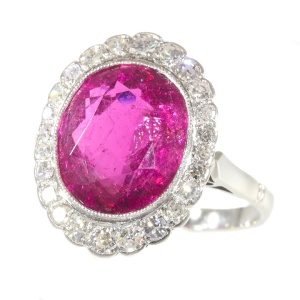

A gemstone that is generally yellow, ranging from canary-yellow to orange-yellow, but sometimes is colourless or of a wide range of other hues, including pale blue, pale green, pink, golden-brown, andsherry-brown. It is very hard but has strong cleavage and breaks easily; it has double refraction, low dichroism and colour dispersion, and a vitreous lustre, and is pyroelectric.The topaz is often cut as a pendeloque, but sometimes mounted as a mixed cut and some stones (especially when colourless) are brilliant cut. The topaz is resembled by some other gemstones, e.g. thecolourless variety, by diamond, rock crystal, and white corundum; the yellow variety, by yellow sapphire (sometimes miscalled 'Oriental topaz') and yellow quartz (which, when heated, is citrine, andsometimes called 'false topaz', 'Brazilian topaz' or 'Spanish topaz'); the greenish-blue variety, by aquamarine, and the pink variety, by tourmaline (especially pink rubellite).Some yellow topazes change colour by heat treatment, e.g. the rose topaz; but quick heating can remove all colour. There is no commercial synthetic topaz, but the term is sometimes applied to acoloured synthetic corundum. Among the local misnomers that have been applied to topaz is 'Brazilian ruby'.The name 'topaz' was for centuries applied to a stone which was found on the Arabian Gulf Island of Topazos.
Topaz
Topaz
A gemstone that is generally yellow, ranging from canary-yellow to orange-yellow, but sometimes is colourless or of a wide range of other hues, including pale blue, pale green, pink, golden-brown, andsherry-brown. It is very hard but has strong cleavage and breaks easily; it has double refraction, low dichroism and colour dispersion, and a vitreous lustre, and is pyroelectric.The topaz is often cut as a pendeloque, but sometimes mounted as a mixed cut and some stones (especially when colourless) are brilliant cut. The topaz is resembled by some other gemstones, e.g. thecolourless variety, by diamond, rock crystal, and white corundum; the yellow variety, by yellow sapphire (sometimes miscalled 'Oriental topaz') and yellow quartz (which, when heated, is citrine, andsometimes called 'false topaz', 'Brazilian topaz' or 'Spanish topaz'); the greenish-blue variety, by aquamarine, and the pink variety, by tourmaline (especially pink rubellite).Some yellow topazes change colour by heat treatment, e.g. the rose topaz; but quick heating can remove all colour. There is no commercial synthetic topaz, but the term is sometimes applied to acoloured synthetic corundum. Among the local misnomers that have been applied to topaz is 'Brazilian ruby'.The name 'topaz' was for centuries applied to a stone which was found on the Arabian Gulf Island of Topazos.
References
From: An Illustrated Dictionary of Jewelry, autor: Harold Newman, publishers: Thames and Hudson