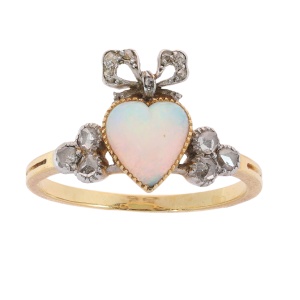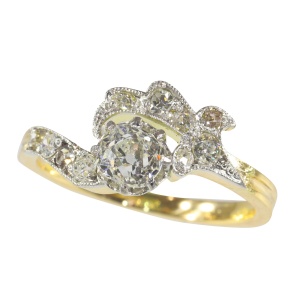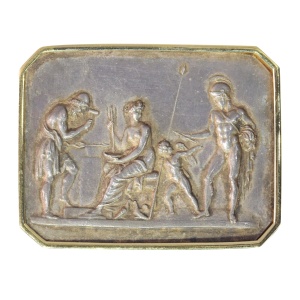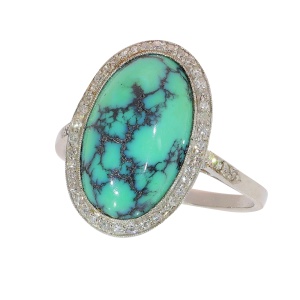

A variety of pyrites (iron sulphide), sometimes called 'iron pyrites'. It is pale brassy-yellow and has a brilliant metallic lustre. It is of the same chemical composition as marcasite and resemblesit, but is of a different structure and lower specific gravity. It is a very common mineral and was used extensively in Europe, especially in France, during the 18th and 19th centuries as a substitutefor diamonds and marcasite.The 18th-century pieces of jewelry were well made, with pavé setting for the stones, which were faceted and polished so that they reflected lightfrom their surface; but in the 19th century pyrite was sued for inexpensive jewelry, being cemented in the setting instead of having a rub-over setting. It was set in silver or some white metal ratherthat more expensive and less harmonious gold. Small stones have for centuries been rose cut and set in cheap jewelry. It was used in buckles, finger rings, buttons, combs, etc., and sometimes was setin narrow rows to form bow-knot brooches or in the frames of cameos in lockets.The centre for cutting pyrite (so-called 'marcasite') is in the Jura region of France, where the pieces are generally cut as low six-sided pyramids. Pyrite is found in particles dotting lapis lazuli.It is sometimes called 'fool's gold'.
Pyrite
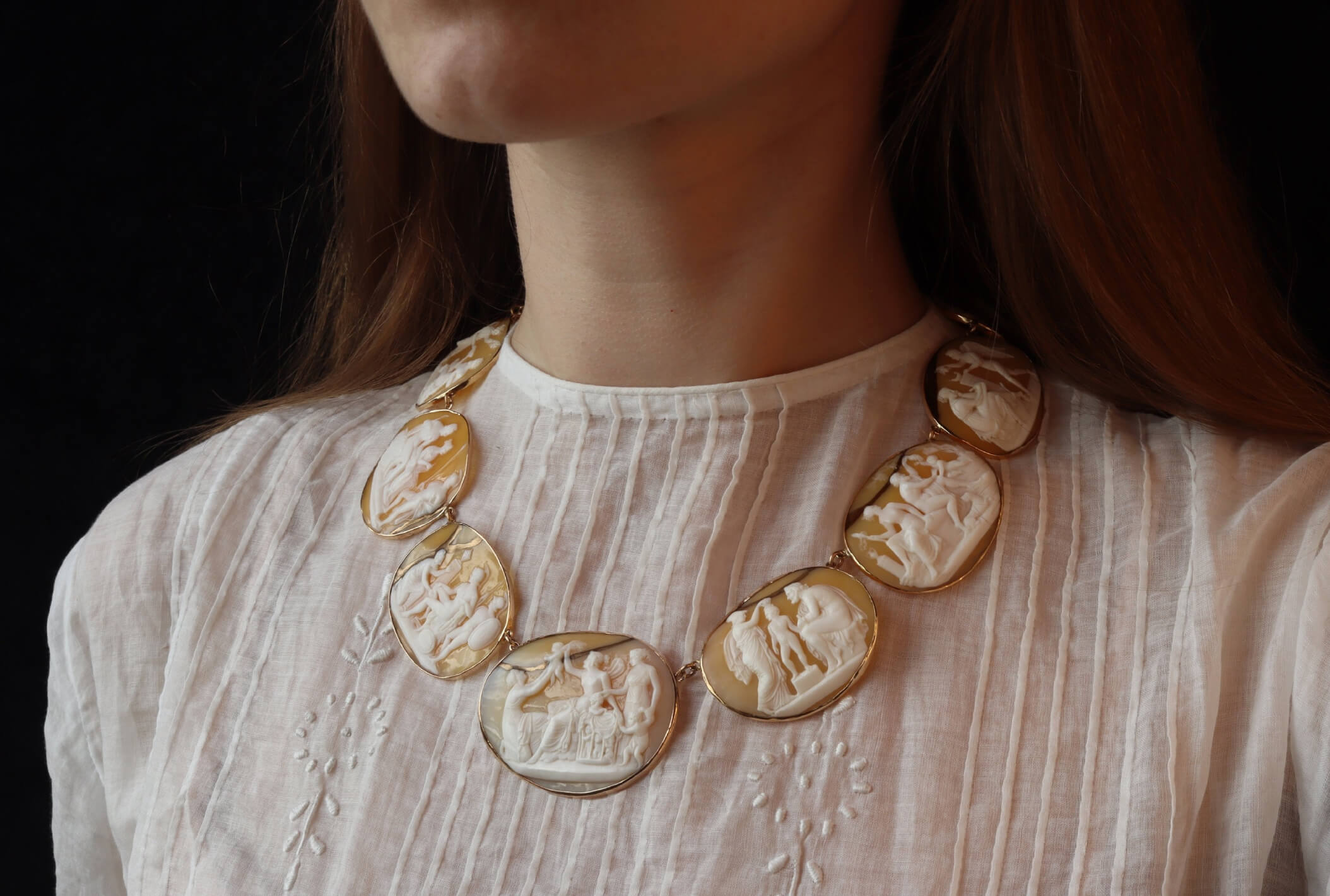
Pyrite
A variety of pyrites (iron sulphide), sometimes called 'iron pyrites'. It is pale brassy-yellow and has a brilliant metallic lustre. It is of the same chemical composition as marcasite and resemblesit, but is of a different structure and lower specific gravity. It is a very common mineral and was used extensively in Europe, especially in France, during the 18th and 19th centuries as a substitutefor diamonds and marcasite.The 18th-century pieces of jewelry were well made, with pavé setting for the stones, which were faceted and polished so that they reflected lightfrom their surface; but in the 19th century pyrite was sued for inexpensive jewelry, being cemented in the setting instead of having a rub-over setting. It was set in silver or some white metal ratherthat more expensive and less harmonious gold. Small stones have for centuries been rose cut and set in cheap jewelry. It was used in buckles, finger rings, buttons, combs, etc., and sometimes was setin narrow rows to form bow-knot brooches or in the frames of cameos in lockets.The centre for cutting pyrite (so-called 'marcasite') is in the Jura region of France, where the pieces are generally cut as low six-sided pyramids. Pyrite is found in particles dotting lapis lazuli.It is sometimes called 'fool's gold'.
References
From: An Illustrated Dictionary of Jewelry, autor: Harold Newman, publishers: Thames and Hudson