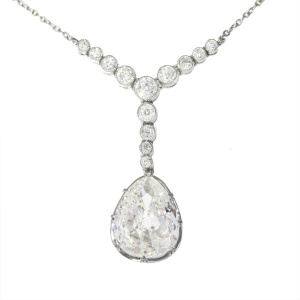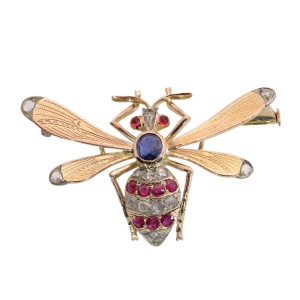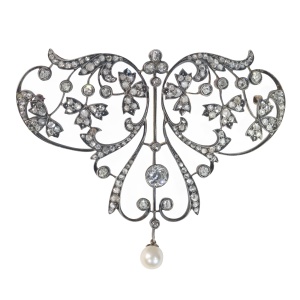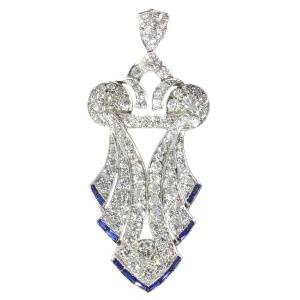

A style of cutting a large diamond (or other transparent gemstone) so that, below the table, there are a number of sloping, parallel rows of four-sided (isosceles-trapezoidal) facets that increasein size as they approach the girdle and then decrease as they descend to the culet, and thus give the impression of steps. The number of rows above the girdle is smaller than the number below, but thenumber of rows can vary, depending on the size of the stone.The shape of the table (and thus of the stone) is usually square, rectangular, hexagonal or octagonal, but some stones are cut with the table as oval, semi-circular (Lunette), Lozenge-shaped,trapezoidal, drop-shaped, etc.; on some the corners are chamfered. The cut emphasizes the stone's colour at some loss of brilliance, and so is used mainly for coloured stones. Also called 'trap cut'.
Step Cut
Step Cut
A style of cutting a large diamond (or other transparent gemstone) so that, below the table, there are a number of sloping, parallel rows of four-sided (isosceles-trapezoidal) facets that increasein size as they approach the girdle and then decrease as they descend to the culet, and thus give the impression of steps. The number of rows above the girdle is smaller than the number below, but thenumber of rows can vary, depending on the size of the stone.The shape of the table (and thus of the stone) is usually square, rectangular, hexagonal or octagonal, but some stones are cut with the table as oval, semi-circular (Lunette), Lozenge-shaped,trapezoidal, drop-shaped, etc.; on some the corners are chamfered. The cut emphasizes the stone's colour at some loss of brilliance, and so is used mainly for coloured stones. Also called 'trap cut'.
References
From: An Illustrated Dictionary of Jewelry, autor: Harold Newman, publishers: Thames and Hudson