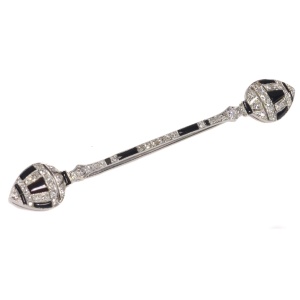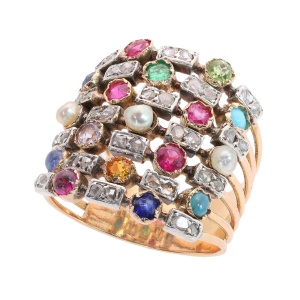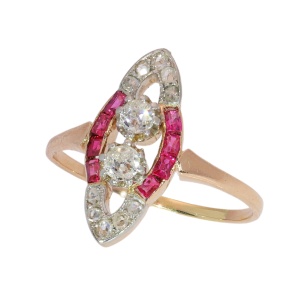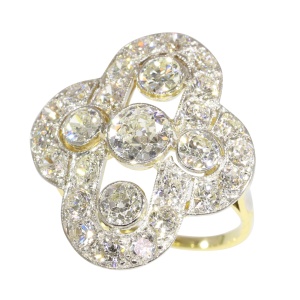

The style of cutting a diamond (or other transparent gemstone) by removing the natural points of an octahedral crystal, leaving a flat square or rectangular table at the top and a similar but very muchsmaller parallel flat surface (culet) at the bottom, with four abutting isosceles-trapezoid-shaped facets sloping upward and four downward from the girdle (if the sloping facets are given chamferedcorners, the number of sloping facets is increased from 8 to 16).This cut was introduced in the early 15th century and continued until the introduction of the rose cut in the mid-17th century. A later modification has, extending downward from the girdle, 4triangular facets that meet at a point at the bottom instead of a culet. Such table-cut stones are described as 'thin cut' or 'thick cut', depending upon the depth of the stone.
Table Cut
Table Cut
The style of cutting a diamond (or other transparent gemstone) by removing the natural points of an octahedral crystal, leaving a flat square or rectangular table at the top and a similar but very muchsmaller parallel flat surface (culet) at the bottom, with four abutting isosceles-trapezoid-shaped facets sloping upward and four downward from the girdle (if the sloping facets are given chamferedcorners, the number of sloping facets is increased from 8 to 16).This cut was introduced in the early 15th century and continued until the introduction of the rose cut in the mid-17th century. A later modification has, extending downward from the girdle, 4triangular facets that meet at a point at the bottom instead of a culet. Such table-cut stones are described as 'thin cut' or 'thick cut', depending upon the depth of the stone.
References
From: An Illustrated Dictionary of Jewelry, autor: Harold Newman, publishers: Thames and Hudson