

Chronicles


Merry whatever-you-celebrate and peace for all!!!
Thank you for having the good taste to call upon our expertise.
From Elkan Wijnberg, CEO of Adin, and the entire Adin-team

Flowery icicles discovered in the Garden of Adin
So it was that a blizzard came up at evening and covered the Garden of Adin, and in the morning the snow lay all around the camp. And when the layer of mist lifted, there, on the surface of the wilderness, was a small sparkling substance, as fine as frost on the ground. And the Gardener picked it up and he was happy.
Click here for more information on this beauty.

Winter merriment in the Garden of Adin
In the frosty Garden of Adin,
(while pelting snowballs at his beloved offspring)
much to the Gardener's joy and surprise
a bracelet was found
sparkling with glimmering ice.
Click here for more information on this beauty.

Neo Etruscan crucifix in original box
Top notch quality!
There are crosses, and then there are crosses, but this one is one of the nicest of its kind that we have ever come across. Skilfully crafted with filigree and granules, it is a real joy for the eyes. The corpus is three-dimensionally worked out, and the aureole is also made using the finest filigree and granule technique. It comes in its original box with the text: "Luigi Freschi - Via Condotti - 55, 55a, 56, 57, Corso Umberto 1º 401 - ROMA".
In the second half of the 19th century, goldsmiths of that era sought and found their inspiration in excavations such as Pompeii and the Etruscan treasures. Especially in Italy, the so-called Neo-Etruscan style reached high levels, as we can see here with this beautifully refined cross.
This jewel features a filigree decoration, which is, in fact, thin golden wire twisted into refined motifs, in this case, elegant little balls. You can also notice the use of granulation on this piece. Granulation is a technique where the goldsmith uses very small balls (granules) of metal, which are not soldered to the piece but welded. Both techniques demand very high skills and precision from the maker.
Click here for more information on this beauty.
a marriage of centuries"
~ A kiss on the hand may be quite Continental, but diamonds are a girl's best friend. ~
Although Marilyn Monroe sang about them in 1953, diamonds are thought to have first been recognised and treasured as gemstones and religious icons in ancient India (where they were mined too). The usage of diamonds in engraving tools also dates back to early human history. The name diamond is derived from the ancient Greek "adámas," meaning "unbreakable, untamed."
In 1475, Lodewyk (Louis) van Berquem, a Flemish stone-polisher from Bruges, Belgium, introduced the concept of absolute symmetry in the placement of facets on the stone. The 17th-century French jeweller, Jean-Baptiste Tavernier (1605-1689, also with Belgian roots), was one of the early pioneers of the diamond trade with India. In his book "The Six Voyages of Jean-Baptist Tavernier" he documented many historically significant diamond cuts.
The popularity of diamonds has risen since the 19th century because of increased supply, improved cutting and polishing techniques, and growth in the world economy. And in our days, we at Adin, based in Antwerp - Belgium, are offering the splendours of craftsmanship from diamond polishers and goldsmiths of many centuries. This reflects itself in the diamond jewellery we have to offer from the 17th century onwards.
See all Adin's diamond earrings
See all Adin's diamond pendants
See all Adin's diamond brooches
See all Adin's diamond jewelry

In the hands of the beholder?
French Art Deco platinum lorgnette (a real eye-catcher)
A lorgnette (or face-à-main) is a pair of glasses (or opera glasses) held by a long handle at one side, mostly used by well-to-do ladies. This particular type of lorgnette has a hidden system in its stem that, by moving it slowly down with the tip of your fingers, will release a spring that will open the closed lorgnette with one glass and transform it into a double-glassed lorgnette.
Crafted in platinum and richly adorned with rose-cut diamonds and little carré calibrated stones, this utensil is a true jewel.
Click here for more information on this beauty.

Look what we found!
Antique head parure from Zeeland, Holland.
Although we do not think this is something you would wear, it can be a valuable addition to an antique jewellery collection. A very complete headset from Zeeland, which is in the west-southern part of Holland, to be more specific from the area called Walcheren. To find a complete set is special because mostly these sets are split up among different heirs at legacies. This typical wear for a Zeeland country woman (or farmer's wife) was worn in the 19th Century until our days. Today, there aren’t nearly any people left who wear the dress of this local distinctive style. While the youngsters do not wear it at all anymore, the older people do wear it occasionally. And in 2003, the last two men wearing the traditional clothing died and, most probably in another 10 to 15 years, no woman will be wearing it anymore either.
What is she wearing, you would ask. Well, she is actually wearing more than you can see. First of all, over her back-combed (long) hair with the front of her hair in what is called in the local dialect “toer” (pronounce “tour”), she is wearing a starched so-called “ondermuts” (Dutch for the little lace coif that is worn under the cap you see). Over this coif, the actual headset was placed. This headset is called “ijzer” (Dutch for “iron”). The reason why it's called “iron” doesn’t do it much justice as it is made of a U-shaped silver brace that goes over the back of the head to both temples. At both ends of this brace, the gold curls are attached. Most of the time, the weight of the golden curls is engraved in the back of the silver brace, as is the case here. It gives us the weight of 32 grams.
Then over this brace, the final cap, called “langette”, (also stiffly starched) was placed and held into its position with three gold needles at both sides of the head. These three needles are in three different sizes and made in gold filigree. Then, last but not least, to finalize the outfit, at both curls the actual jewel, a pendant, was attached, a sort of triangle plate with low pyramid shapes on it and a baroque pearl hanging underneath.
And then when it started to rain, the women hated it because when their stiffly starched caps became wet and soft, all their work was for nothing.
Click here for more information on this antique jewellery rarity.

Art Retro
Retro Style is a recent designation for the period in the forties when large scale, stylized geometric forms, drapes, bows, or ribbons were all the rage. The Retro style was strongly influenced by its predecessor: the Art Deco style. It used the same type and language of geometrical shapes but with bolder, heavier lines, shapes, and stones.
Typical for the Retro style is its imitation of three-dimensional folds of fabric, with the ribbon bow as its most popular motif, often highlighted in the center with a calibré cut ruby or sapphire knot (mostly lab-produced stones were used, see also Verneuil rubies and sapphires) and diamonds in various cuts as white accents.
That gold regained its popularity during the Retro period was due to the fact that platinum was not available to the goldsmiths and jewellers since it was being used for the war effort. This was the main reason that during the Retro period, different colors of gold became popular—yellow gold was combined with rose gold and green gold in striking combinations. In France, goldsmiths worked with no less than 27 shades of colors of gold.
Click here to see a close-up of this strong design retro brooch.

One of the joys of life...

Autumn in the Garden of Adin
Vanitas vanitatum et omnia vanitas
In all we do, and hear, and see,
Is restless Toil, and Vanity.
While yet the rolling earth abides,
Fashion comes and goes like ocean tides;
And ere one style dies,
Another trend shall rise;
That, sinking soon into the grave,
Others succeed, like wave on wave;
Part of the poem "Vanitas Vanitatum, Omnia Vanitas."
by Anne Brontë (1820-1849)
(freely rendered)
In the arts, vanitas is a type of symbolic still life painting especially associated with Northern European painters in Flanders and the Netherlands in the sixteenth and seventeenth centuries. The word is Latin, meaning "emptiness" and loosely translated corresponds to the meaninglessness of earthly life and the transient nature of vanity. By the 16th century, flowers would appear (again) as symbols of the seasons. Starting in Roman times is the tradition of using symbols of mortality, transience, and earthly remains. These so-called vanitas images have been re-interpreted through the last 400 years of art history, starting with Dutch painters around 1600. It is from these paintings that the Gardener took his inspiration for this Garden of Adin Vanitas Vanitatum.
Click here to see a close-up of this beautiful Dutch rose cut diamonds brooch.

Flowers are love's truest language
(But sometimes even the truth needs a little help)
Flowers are part of our daily life. For virtually every event, we have assigned a special flower. Flowers for love, church, church graveyard, marriage, etc. In the 16th century, inns used to have a branch or flower stalk as a signboard, which later often changed only into the name of a specific tree or flower. Many times one finds flower gardens in mythological sceneries. The allegoric use of flowers is uncountable: attributes for springtime, youth, sunrise, rhetoric, virtue, etc. Lots of countries carry a flower as a national symbol: Hungary has the tulip and Scotland the thistle, etc.
On our site, we have dedicated a page to flower symbolism where you can read much more about the symbolism behind the use of floral motifs. Enjoy!
Click here to see a close-up of this magnificent Art Deco ring.

Yes, love grows on trees...
In the Garden of Adin,
in a gentle morning breeze,
Adin's paladin
bent to his knees
and found love...
growing on trees.
Click here to see a close-up of this beautiful heart-shaped pendant.

It was a moonlit night...
Once upon a moonlit night, two hearts blended, love surrendered, with embracing arms, remember (borrowed from a song by Frank Sinatra).
In Antiquity, as well as in the Middle Ages, people believed that the cosmos is reflected in gemstones. Christian, Jewish, Muslim, Hindu, and Buddhist traditions mingled with Pagan legends led to the association of certain precious stones with different days, months, astrological signs, Tribes of Israel, and Apostles, but also with healing powers for social, physiological, metaphysical, and even medical conditions.
The moonstone is assigned to the planets Neptune and Venus. The combination of moonstone with Venus is interesting as it's still today considered to be a woman's stone. The moonstone is the birthstone or month stone for June. Moonstone is said to protect travellers, especially from danger by sea, reconcile lovers, bring good fortune, inner growth, and strength. (Not that we necessarily promote or believe such claims, but we think they make for interesting conversation.)
In semi-precious stones, there are gems and gems, but this cabochon-cut moonstone is the gem of gems. This top-quality fine blue moonstone shows an incredible "three-dimensional" depth of color, which one will see clearly only when playfully tilting the stone and moving it. Transparent with a violet hue when playing with it in the light. Blue moonstones of fine quality are becoming increasingly scarce, pushing up the prices accordingly, and to find one of this size is even rarer. Executed in platinum with six old mine brilliant cut diamonds in line pointing towards the moonstone, this jewel is an example of how frugal and yet beautiful Art Deco can be.
Click here to see a close-up of this beautiful moonstone pendant.

Archaeological-revival necklace attributed to Fontenay
ANTWERP, September 16 – It is with great pride that we offer this magnificent necklace here. A true museum piece that we are thrilled to have in our collection. The continuous uniform fringe decorated with beads, wirework, and florettes of this necklace is typical for the work of Eugène Fontenay. A demi-parure of a very similar design is illustrated in French Jewelry of the Nineteenth Century by Henri Vever, translated by Katherine Purcell, p. 643. A similar necklace, along with matching earrings, was sold in 2008 at Sotheby's for $52,000!
The archaeological revival is the appellation for neo-styles of the 18th and 19th centuries that were inspired by discoveries in the excavations of Roman, Egyptian, Hellenistic, and Etruscan sites. The first revival in the 18th century, which is called neoclassicism, came after excavations of the cities of Pompeii and Herculaneum. The second revival was inspired by finds in Etruscan burial sites (in Italy). In jewelry, this style is characterized by granulation and filigree decorations.
There is some discussion among experts on who rediscovered the granulation technique. To some, it was Castellani in the 19th Century, but various methods of manufacturing and handling of granules have been described by Pliny in 79 AD, V. Biringucchio in 1540, G. Agricola in 1556, B. Cellini in 1568, M. Fachs in 1595, and A. Libavius in 1597/1606. In fact, never since it was first used has granulation been a lost art. Until far into the 19th Century, the time of its alleged 'rediscovery', this technique has thrived continuously in many places like Russia, Bulgaria, Mongolia, Tibet, and Persia. This also holds true for Swiss, German, and Dutch folk-jewelry.
Eugène Fontenay (1823-87) was one of the foremost goldsmiths in France during the second half of the nineteenth century. He was a great admirer of the ancient techniques of granulation and filigree and became best known for his outstanding work in the 'archaeological' style. Fontenay was no doubt inspired by the Campana collection of ancient jewellery, acquired by Napoleon III in 1860, and his firm produced much work in the antique style based on Greek, Roman, and Etruscan examples.
Click here to see a close-up of this magnificent necklace.

Noah related gold artefactin the Garden of Adin
ANTWERP, September 12 (Reuters) – Local archaeologists have made an important discovery at the Garden of Adin which might lead to a reconsideration of the history and landscape of the site. A report in The Heavenly Inquirer states that the findings include a Caucasian ear pendant made some 1,600 years ago. According to Elkan Wijnberg, general supervisor of antiquities in the Garden of Adin, the discovery of the Caucasian ear pendant is a clear proof of the historical value of the site. He explained to us that Caucas, the ancestor of the Caucasians, was the son of Togarmah, who was the son of Japheth, who was the grandson of Biblical Noah. He also mentioned the existence of a similar ear pendant in the famous collection of the jewellery museum in Pforzheim, Germany.
Click here to see a close-up of this magnificent ear pendant.

Flowers of gold in the Garden of Adin
ANTWERP, September 06 (Reuters) – While weeding the garden, the Gardener stumbled upon a peculiar branch of flowers that was hidden among the tares. Local specialists at the Garden of Adin told us the branch, which consists of three colours of gold and is richly adorned with rubies and diamonds, was made somewhere in the 1950s.
Click here to see a close-up of this magnificent bouquet.

We saw it through the grapevine
ANTWERP, August 30 (Reuters) – Rumours have reached us that the Gardener of Adin is offering the above-pictured bar brooch at a reduced price to Adin's followers. When confronted, the Gardener confessed. He told us that the price of the brooch had been reduced by €1,000, which is almost $1,500! In a later statement, he testified that this was done in an attempt to reduce the presence of crystallized carbon in the Garden of Adin to meet standards set in the Kyoto Protocol.
Click here to see a close-up of this magnificent bar brooch.

Sleeping Beauty Pendant
ANTWERP, August 23 (Reuters) – Once upon a time in the Garden of Adin, not so far away from here, the Gardener was pruning the roses when he stumbled upon this sleeping beauty pendant. It must have been asleep there for some 100 years, just waiting to be awoken. We hope that we can assist in its desire to be worn by a princess.
Click here to see a close-up of this sleeping beauty pendant.

Ad ogni uccello suo nido è bello (With every bird, its own nest is charming)
ANTWERP, August 16 (Reuters) – During the absence of the Gardener for his sabbatical leave this year, it seems that some birds used the quietness in the Garden of Adin to multiply. A bird-spotter spotted a hatching pair of birds and had Adin's photographer called to make a snapshot of the little love couple. We wonder what their eggs will hatch.
Click here to see a close-up of these birds on their nest.

Atrocities in the Garden of Adin
ANTWERP, 9 August (Reuters) – In the Garden of Adin, a rather beastly situation arose during the Gardener's absence on his annual holiday. An alert passer-by noticed a serpent stalking a dragonfly and promptly notified Adin's photographer, who managed to capture an image just seconds before the atrocity occurred. We can only hope that upon his return, the Gardener's livestock won’t have diminished too much.
Click here to see what is left of the Gardener's livestock.

Holidays in the Garden of Adin
ANTWERP, August 02 (Genesish) – And his wife said to the gardener: "Behold, I need a break! Build me an ark in the sky and give me entrance into a brightly lit place. And behold, I will bring a good mood flood upon the earth." But the gardener wanted to take all his things of gold, many of each he wanted to preserve with him; but his wife threatened to end their covenant. And thus, the gardener and his family went on holiday without their jewellery; according to all that his wife had commanded him, so he did.
Wishing all our friends, customers, and colleagues a relaxing vacation!
Click here to get to the description of the ring.

A royal shade of purple in the Garden of Adin
ANTWERP, July 26 (Reuters) – In medieval Europe, purple was worn by kings as blue dyes were rare and expensive, and only the most wealthy or the aristocracy could afford to wear them. Therefore, it is not unexpected that Adin's gardeners found blooming evidence of the origin of this colour in the Garden of Adin. Chief researcher Elkan Wijnberg said in an exclusive interview with The Heavenly Inquirer that he had never seen an amethyst in such ethereal purple before.
Click here to get to the descriptive page of this amethyst brooch pendant.

Superb 18th Century cameo
Two weeks ago, we were fortunate to be offered an impressive private collection of antique jewellery. The person who brought it to us had inherited it from his parents, antique jewellery dealers who retired some 30 years ago, and he wanted to find a good home for it. We felt honoured that he came to us and were amazed by the quality of this collection. One could see the love these people had for antique jewellery.
Among the many high-quality pieces we received was one truly amazing cameo. It took us many hours to determine where the cameo came from and what it depicted, and the result is astonishing.
If you want to find out about this cameo, just click here.

End to plague in The Garden of Adin
ANTWERP, July 12 (Reuters) – Last week's mosquito plague that descended over the Garden-of-Adin turned out to be a heavenly gift for the local spiders. Independent observers have told us that they had never seen spiders as well-fed and healthy as at Adin.
Click here to get to the descriptive page of this spider.

Swarmings above The Garden of Adin
ANTWERP, July 05 (Reuters) – At the beginning of the evening and the morning of the fourth day of this week, Adin's observer exclaimed: “Behold! There is a swarming of living creatures across the expanse of the heavens above the Garden-of-Adin!”. And Adin's helpmate brought it to man to see what he would call it. And the man named it “stickpin,” that was its name. And we saw all that Adin found, and behold, it was very good.
(It's our belief that any resemblance to similar situations in history is purely coincidental.)
Click here to get to the descriptive page of this stickpin.

Serpents and apples in The Garden of Adin
ANTWERP, June 28 (Reuters) – Well-informed sources at Adin, Antwerp - Belgium, have reported that they are being overwhelmed with requests for information on the exact whereabouts of the Garden-of-Adin. For obvious reasons, the exact location of this garden and its treasures is kept a secret. However, we were told that the Adin team is planning to offer some of the treasures they discover on their website.
At the beginning of this week, in the midst of the garden, a serpent was discovered. But behold! When Adin's photographer attempted to create an image of this illustrious animal, he found it entwined with a mate in a rather intense position on a just-eaten apple.
We believe that any resemblance to other known cases of serpents and apples is purely coincidental.
Click here to get to the descriptive page of these serpents.

Another mystery in The Garden of Adin
ANTWERP, June 21 (Reuters) – Botanists at Adin, Antwerp - Belgium, have discovered a previously unknown flower in their garden. They suspect the plant belongs to the family of the Pansy (Viola Tricolor Hortensis). Lead author and researcher Elkan Wijnberg at Adin Antique Jewellery suggested naming this flower Viola Albino Diamantes. Soon, an article will be published in the magazine of Adin's Association for the Advancement of Science (not to be confused with the American Association for the Advancement of Science - AAAS). We'll keep you updated!
Click here to get to the descriptive page of this flower.

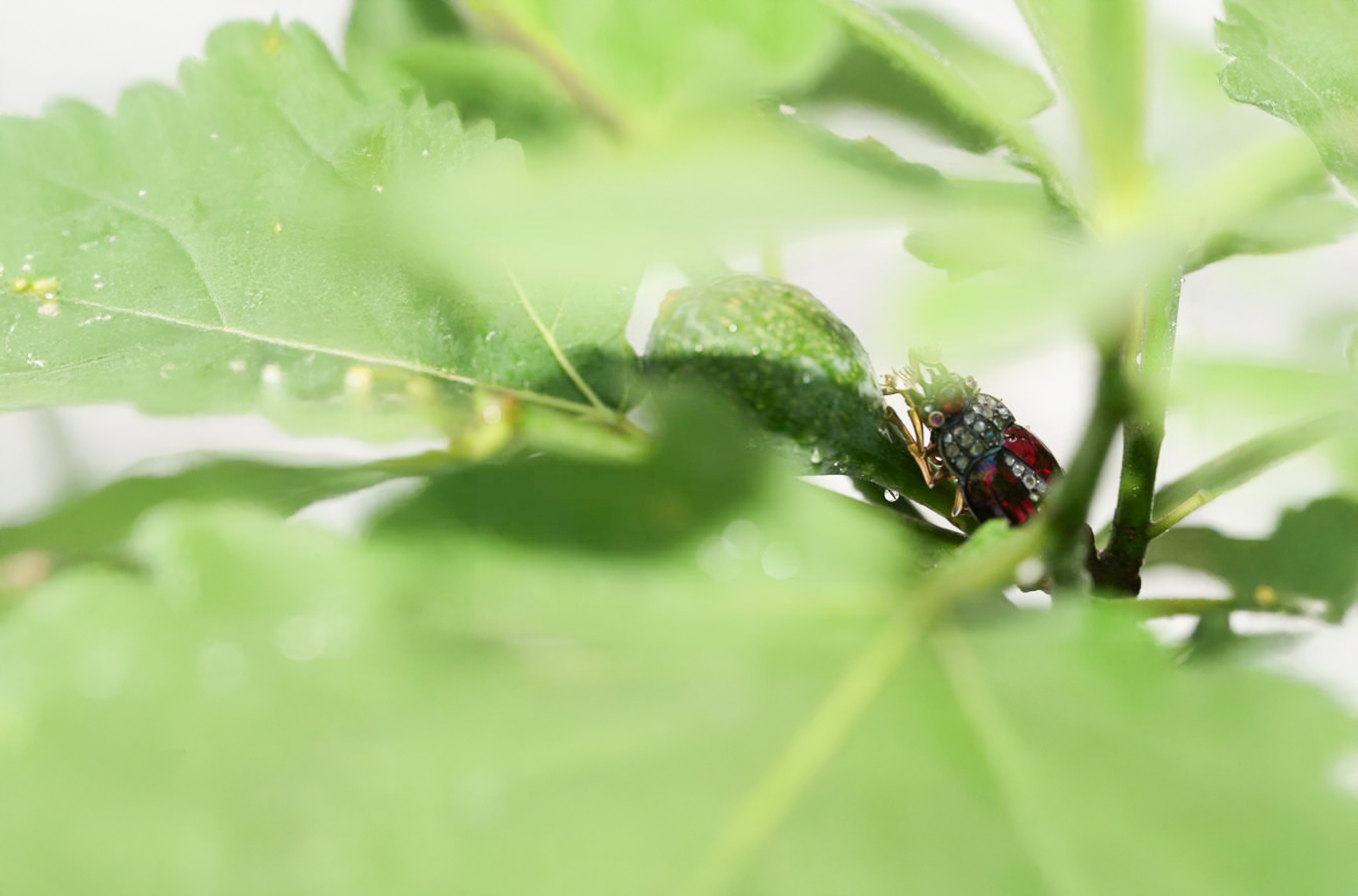
Exotic beetle spotted in garden of Adin
ANTWERP, June 14 (Reuters) – Entomologists at Adin, Antwerp - Belgium, have discovered an exotic beetle in their garden. How or when the insect arrived is unknown, but "Our study convincingly shows that there is a link between global warming and bejewelled insects hiding under leaves," said Elkan Wijnberg, lead author and a researcher with Adin Antique Jewellery.
Click here to see all the pictures our photographer was able to take of this insect.

How Art Deco got its name
One of the major design events of the 1920s, if not the most important, was "L'exposition Internationale des Arts Décoratifs et Industriels Modernes," which translates from French as "The International Exposition of Modern Industrial and Decorative Arts". This World's fair was held in Paris, France from April to October 1925.
The term Art Deco was derived by shortening the words Arts Décoratifs in the title of this exposition and described designs in terms of a broad decoratively "modern" style, influenced strongly by Decorative Cubism. One of the members of the Admission Committee for the jewellery department of this trailblazing fair was the maker of the pin we show here, Mr. George Fouquet.
George Fouquet (1862-1957) is recognized as one of the very few and best-known artist jewellers of his time. He won many international awards and worked closely together with artists of his era, like Alfons Mucha. George Fouquet's jewellery can be found in collections of many important museums all over the world; from the Victoria & Albert in London to The Metropolitan Museum of Art in New York. He bequeathed his archive and designs to the Musée des Arts Décoratifs in Paris.
The so-called jabot pin by George Fouquet we show here is as close as one can get to the source of pure Art Deco jewellery.
Click here to get to the descriptive page of this pin.

A lady came into our store...
A lady came into our store offering us an antique silver chain. She knew it was antique because she had a dated picture of her grandmother wearing it. She showed us the picture, and indeed, when looking at the picture through our jeweller's loupe, we saw the same chain. The back of the picture listed the dates 1911, 1912, and 1913.
Normally, we do not deal in silver jewellery, but this is so much more than "just jewellery". This is what our trade is all about—the link between us and our ancestors documented in a dated picture. The lady sold us the chain along with the picture, and we are proud to offer it here among our gold, platinum, and diamond jewellery. The combination of an antique photograph with the original chain depicted on it is truly unique!
When looking closely at the picture, we see a young woman with the, in those days, fashionable wasp waist and sautoir (long chain). The tightly bound wasp waist was the ultimate standard of feminine beauty. Although average waist measurements varied between 50 and 58 cm (20 and 23 inches), women tortured themselves with special corsets to achieve measurements between 40 and 45 cm (16 to 18 inches).
We can also recognise the name tag she is wearing on her dress; Catherine. We do not think that Granny Catherine would have ever imagined that people would still be speaking about her 100 years later.
Click here to get to the descriptive page of this chain.

Sweet jewelry...
This must be one of the most elegant rings we have ever had. It combines the graceful finesse of the Edwardian style with the very geometrical forms of Art Deco. This mixture of styles is not surprising, as both Edwardian and Art Deco are contemporaneous.
The centre is set with a high-domed cabochon cut natural sapphire. Such sapphires are called "pain du sucre," which is French for sugar loaf. A sugar loaf, a tall, gently-tapering cylinder with a conical top, was the traditional form in which refined sugar was exported from the Caribbean and eastern Brazil from the 17th to 19th centuries.
A sweet piece of jewellery indeed.
Click here to get to the descriptive page of this ring.

Antwerp...Diamond capital of the world for centuries - not just an empty phrase.
Of all cities, it was our hometown, Antwerp, where, in the mid-16th century, the table rose-cut diamond was introduced. This method of diamond polishing left both the top and bottom of the stone flat, with sloping facets and chamfered corners, creating a sort of trapezium. One can recognise the old 16th, 17th, and 18th-century rose cuts by these flat tops, known as the “table”. Later rose-cut diamonds were polished to a point at the top.
Imagine the ingenuity and patience people had in those days to polish the world's hardest material into the shape of their desire. The jewels depicted here are set with these so-called table rose cuts and are about 300 years old. Just imagine wearing jewellery that ancient...


From manure to jewelry.
The unlikely evolution of the dung beetle: In the Old Kingdom of Ancient Egypt, the use of the dung beetle (also called the scarab) as a symbol became common. The dung beetle's rolling of dung into a ball was seen as an earthly symbol of the heavenly cycle. Crafted in bone, ivory, stone, Egyptian faience, or precious metals, they were often incorporated into tombs as grave goods or given as 'gifts'. Over centuries, up to our days, for people with a fascination for the art and beliefs of ancient Egypt, the scarab remains an item of popular interest.
In the past 200 years, Ancient Egypt has been a rich source of inspiration to art and fashion worldwide, influencing at least three periods. We call these periods the Egyptian revivals or Neo-Egyptian styles, and they are divided as follows:
- The first was initiated by Napoleon Bonaparte's Egyptian Campaign, circa 1797.
- The second by the construction of the Suez Canal in 1859 and its official opening in 1869.
- The third by the discovery of the tomb of King Tutankhamun in November 1922.
We think the ring pictured here was made in Egypt somewhere between 1920 and 1930. Perhaps it was not even made as a result of the third Neo-Egyptian revival, but just to sell to tourists. It could also be questionable whether the scarab is originally from the Ancient Egyptian era or specially made to look old, as there are no reasons to believe that the tourist industry, in general, has changed over the years.

It is not only fine feathers that make fine birds.
Although Aesop (a Greek storyteller who lived from 620-560 BC) meant something else with his saying, he couldn't be more accurate for the bird pictured here. If something has been lost over the years in the art of jewellery making, it is the cooperation of various disciplines that are needed to create one well-designed and well-made piece of jewellery. The artist/designer, the modeller, the goldsmith, the setter, the engraver, and the polisher, all contributed their expertise.
As is the case with this strange bird here, a typical product of the 1950s. All sorts of animals were used as sources of inspiration. Made of gold and precious stones, sometimes even decorated with enamel, the result of the experts' collaboration was, most of the time, well-made, clever, and cute.
The special thing about this bird, besides its funny and well-made appearance, is the stone used for its eye—a beautiful, velvety light-green coloured natural demantoid of nearly half a carat, that adds a new dimension to the meaning of the word "sparkle". Proving that only the best of the best was used in such pieces. Demantoid is the most expensive and rare of the garnet gemstones, with fine specimens like the one used here commanding prices of thousands of dollars per carat—more expensive than diamonds!

Quelle heure est-il?
Even the French way of asking for the time is elegant... Belgium and its monarchy as we know it today only exists since 1831. So to speak of a typical Belgian style would be a bit exaggerated. It is more that Belgian culture is strongly influenced by, on one side, Holland and on the other, France. It is not that long ago that speaking French was considered chic and elegant, while Flemish (a Dutch dialect) was seen as coarse and common.
Being focused on French culture, Belgian jewellers would let themselves be influenced by the big French jewellery houses. This is the case with this ladies' bracelet watch from the Brussels' jeweller Altenloh, one of the very few jewellery suppliers to the court in Belgium. The jewel is a typical example of a high-quality ladies' watch in Retro style, where the watch is hidden behind a bejewelled hinged shutter. We browsed through our library and were surprised not to find a picture of this beauty in any book.

sigh... love, love, always love
Love in flower symbolism
In the late 19th, early 20th century there was a revival of the use of symbolic meanings of plants and flowers. Nature seemed to be a forest of symbols, and flowers were saturated with deeper meanings.
As is the case with the late 19th century French elegant necklace we show here. We clearly recognize an ivy. But what is so romantic about the ivy you would say. The romantic facet of ivy is based upon its tendrils which attach to a wall in a way that can be explained as affectionately. In France one would give a piece of jewelry with ivy depicted on it while saying "Je m'attache ou je meurs" which (freely) translates to "I will cling to you or I will die"...
This hidden meaning is what we like about our antique jewelry, it gives the piece an extra depth. The added emotional value that is not necessary obvious to all but just between the donor and the receiver.

They can't both be Art Deco

Many people mistakenly designate the style of both rings as Art Deco. However, while the ring with the red stones is indeed Art Deco, the style of the ring with just diamonds is called Retro (perhaps even early Fifties). That both styles are mingled is no great surprise, as one is strongly influenced by the other. The Retro style uses the same type and language of geometrical shapes as its predecessor, the Art Deco style, but with bolder, heavier lines, shapes, and stones.
The Art Deco style was introduced in the 1920s as a reaction against the dreamy (sometimes even hallucinatory) Art Nouveau style, and it ended in the 1930s. The style emphasised highly abstract designs with geometric patterns. The baguette and emerald cuts, which had been developed in the nineteenth century, were very popular in the 1920s because they blended perfectly with the geometrical lines of the Art Deco style.
The Retro style, as the successor of Art Deco, flourished between roughly 1940 and 1950. Typical of the Retro style is its imitation of three-dimensional folds of fabric, with the ribbon bow being its most popular motif, often highlighted in the centre with a calibré cut ruby or sapphire knot. In the Retro ring on the right, we can faintly recognise this bow shape.
Sigh... love, love, always love
Love in flower symbolism: In the late 19th and early 20th centuries, there was a revival in the use of symbolic meanings of plants and flowers. Nature seemed to be a forest of symbols, and flowers were saturated with deeper meanings. This is evident in the late 19th-century French elegant necklace we show here. We clearly recognize an ivy. But what is so romantic about ivy, you might ask? The romantic aspect of ivy is based on its tendrils, which attach to a wall in a way that can be explained as affectionate. In France, one would give a piece of jewellery with ivy depicted on it while saying "Je m'attache ou je meurs," which (freely) translates to "I will cling to you or I will die."
This hidden meaning is what we cherish about our antique jewellery; it gives the piece an extra depth. The added emotional value that is not necessarily obvious to all, but just between the donor and the receiver.

1819?
What happened in 1819? In 1819, Alexandrina Victoria was born, who later became crowned Queen Victoria of the United Kingdom. Thomas Jefferson founded the University of Virginia, and for $5 million, Spain ceded Florida to the United States. Ah, and it is the year this box was made.
When looking at the pristine condition of this beautiful box, one can only imagine the care and prudence the many subsequent owners of this box must have exercised over its 200-year-old history. Imagine 200 years! That is about eight generations! With pieces this old, one realizes that one doesn't really own a piece of history, rather one is the temporary guardian of such an object.

The Griffin
A guardian of treasures: The griffin, a strange and legendary hybrid creature, is usually represented as part eagle and part lion, and is commonly known for guarding treasures. The griffin motif is found in sculptures of the ancient Babylonians, Assyrians, Persians, Greeks, and Romans; in beast allegories of the early Christians; and in Gothic architecture of the late Middle Ages. The griffin remains common in heraldry, representing strength and vigilance.
A hybrid is a composite of two or more species of animal and/or human, and the seven most well-known hybrids are:
- The centaur: In Greek mythology and art, the centaur has the torso of a human combined with the body of a horse.
- The cockatrice: This creature, also known as a basilisk ("king of serpents"), could kill with just a glance; the cockatrice was composed of a dragon's tail and assorted poultry parts.
- The giants (gigantes): These fierce and frightening beings were the offspring of Gaia (the Earth).
- The griffin: According to myth, the griffin was a creature with the body of a lion attached to the head, wings, and claws of an eagle.
- The harpy: Harpies had female torsos melded with vulture parts; the name harpy is derived from the Greek word meaning "snatcher".
- The satyrs (faun): Satyrs, often companions of Dionysos, were depicted in myth and art with the legs of goats and bestial natures.
- The sirens: Women with bird-like bodies; sirens were legendary for luring sailors by singing their enchanted songs.
Visit our antique jewelry glossary for a more comprehensive explanation on griffins or click here to get to the descriptive page of this jewel.

An Eastern fairy tale
How are bunnies and hares linked to eggs? Among the many non-religious customs in various religions that originate from pagan celebrations of nature, the Easter Bunny must be one of the cutest. The Anglo-Saxon Easter Bunny and his Continental cousin the "lièvre de Pâques" (French for "Easter Hare") find their origins in the pagan celebration of the return of springtime. Way back in the old days (in springtime), when people would go out to forage for food on the land, they would find eggs in old hare forms and/or rabbit holes (the eggs were laid there by different bird species).
To illustrate this little fact, we would have loved to show you a big Fabergé egg, but we haven't had one in the last 30 years and the chance we'll have one in the coming 30 years is also rather small. Instead, we used the golden pin with a hare head that we do have.

Specific Dutch regional jewelry
This type of necklace reminds me of the days when my interest in antique jewellery was just burgeoning. One of the first books, if not the first book, I bought was about jewellery that was worn with the specific local Dutch costumes. Until the beginning of the 20th century, in some Dutch villages, people were recognisable by their clothes and jewellery. In the Netherlands, many villages had their own costume. Only by looking at a piece of jewellery or clothing, experts can tell from which region people were, what faith they had, and even their marital status.
The type of necklace here is also depicted in that book and is made in Walcheren, Zeeland (the Netherlands). The closure is in 14K two-tone gold (red and yellow), and it has four strings of faceted garnet beads. The closure itself is skilfully embellished with one large and 24 smaller rose-cut garnets, plus six smaller garnets at the sides. Necklaces like this were worn by women of all ages as part of the "klederdracht" (local dress in its distinctive style).
Today, there are hardly any people left who wear the dress of this distinctive local style. While the younger generation no longer wears it at all, the older people wear it occasionally. In 2003, the last two men wearing the traditional clothing died, and most likely in another 10 to 15 years, no woman will be wearing it anymore either.
Click here to get to the descriptive page of this jewel.

Yes, it is a tiara
Some time ago, while walking through the Victoria & Albert Museum in London, a small showcase caught my attention. It displayed objects from bygone eras (not uncommon in a museum) and invited visitors to guess the purpose of these items. Special pliers were used to widen the interior of glove fingers, and silver handles with metal hooks were employed to pull on boots or fasten corsets. It made me realise that humanity has invented so many decorative “useful” objects, only to abandon them just as easily with the changing seasons of fashion.
Will the tiara pictured above be the next item of beauty in this line of superfluity? We think not. Designed and skilfully crafted by our ancestors, they believed a tiara was inextricably linked to the "robe de soirée" (French for “evening gown”). The tiara is an unexpected, surprising, and yet very wearable piece of jewellery. While occasions to wear one are few and far between, the tiara is still regarded as both the figurative and literal crown of the robe de soirée, transforming its wearer into the princess of the night.
Click here to get to the descriptive page of this tiara.


Valentine's day
Because I love you more and more each day,
today more than yesterday,
but less than tomorrow.
https://www.antiquejewel.com/en/2ndpage.asp?dtn=08305-4167&from=mailing-2009-01-19
This jewel became very popular and is still considered today as a token of love. The coded message in it is in French (the language d'amour par excellence!) and reads: '+ qu hier - que demain'. This is inspired by a beautiful and romantic French poem by Rosemonde Gérard called 'Les Vieux', which was intended for Edmond Rostand. It comes from the sentence 'Et, comme chaque jour je t'aime davantage, Aujourd'hui plus qu'hier et bien moins que demain' meaning:
'And because I love you more and more each day,
today more than yesterday
but less than tomorrow'
Valentine's day, where does it come from?
The most likely origin of the habits of Valentine's day is the old belief that birds starting to mate at February 14th. Specially in the Middle Ages this belief was widely spread. In the 14th Century Chaucer writes in Parliament of Foules:
"For this was sent of Seynt Valentine's day, Whan every foul cometh ther to choose his mate."
The sending of love letters at Valentine's day we already see in English and French literature in the late Middle Ages. Not only the message that was send got the name "valentine" but also the involved individuals.

There are many different legends surrounding the origin of Valentines Day. This year, we've opted to tell you the story that originates from the times of the Roman Emperor Claudius II
The legend contends that Valentine was a priest who served during the third century in Rome. When Emperor Claudius II decided that single men made better soldiers than those with wives and families, he outlawed marriage for young men -- his crop of potential soldiers. Valentine, realizing the injustice of the decree, defied Claudius and continued to perform marriages for young lovers in secret. When Valentine's actions were discovered, Claudius ordered that he be put to death.
According to the legend, Valentine actually sent the first 'valentine' greeting himself. While in prison, it is believed that Valentine fell in love with a young girl -- possibly his jailor's daughter -- who visited him during his confinement. Before his death, it is alleged that he wrote her a letter, which he signed 'From your Valentine,' an expression that is still in use today. Although the truth behind the Valentine legends is murky, the stories certainly emphasize his appeal as a sympathetic, heroic, and, most importantly, romantic figure. It's no surprise that by the Middle-Ages, Valentine was one of the most popular saints in England and France.
Finally, unspoken love is like keeping Valentine in prison. Offering a Valentine gift to the one you love would be like releasing him/her by defying Claudius II. Should you be looking for a way of defying Claudius II, just browse our collection with love token jewelry.