

Chronicles
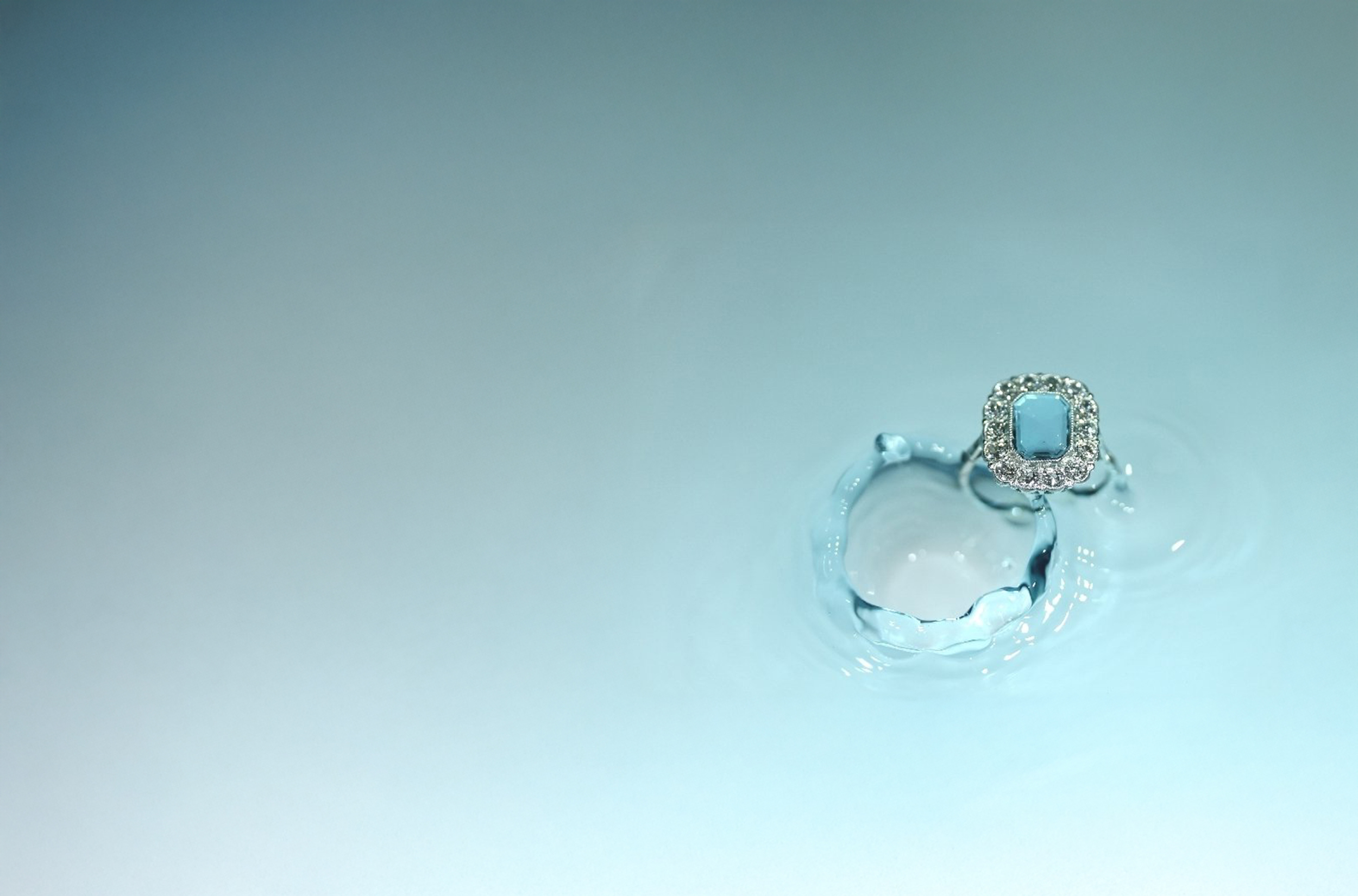


The entire Adin team wishes you A Happy New Year! And may all our children have happy, healthy and rich parents.

Treasures found in The Garden of Adin: Victorian Love Bangle
In this 14K pink gold Victorian love bangle, a playful ribbon encrusted with 42 rose cut diamonds ties together two hearts, each radiating from old brilliant cut diamonds, each centring one of approximately 0.90 carats. As a result of the collision of the two bound hearts, a central lucid pink ruby emerges and shines over the ten brilliant cut diamonds in each of the two shoulders of the jewel. As two hearts become one in this antique bangle, it symbolises a declaration of love lasting through all eras.

Pioneering Delivery for Vintage Jewellery Enthusiasts
Echoing Amazon's Prime Air project, which aims to revolutionise the way goods are delivered by using unmanned drones to deliver packages directly to your doorstep within 30 minutes or less, Adin has developed its own revolutionary delivery system: "The Adin Footstep Saver" (patent pending). Truly, this demonstrates that when it comes to blending the old-world charm with cutting-edge technology, Adin remains leagues ahead of its peers.For the wide selection of Adin's Fine Vintage and Antique Jewellery, all available for direct delivery to your doorstep, visit: www.antique-jewel.com

Once In A Fancy Color Moon (Antique brooch with fancy color diamonds)

Architectural Jewelry (Hide and seek in the Garden of Adin)


Hide, seek and find in The Garden of Adin

Let us color your day!
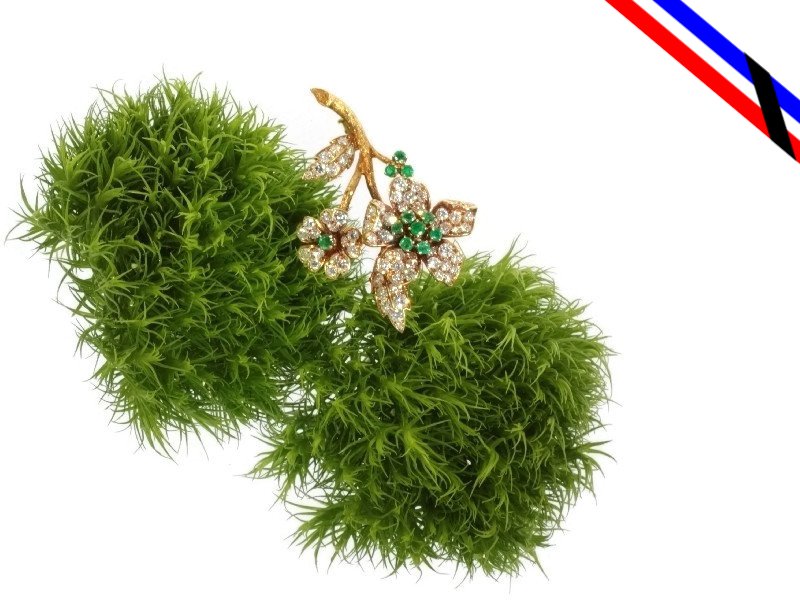
This week's floral suggestion from The Garden of Adin

How to prepare for a white Christmas! (Some - more or less - unbiased advice)
It might be too early, and yet it might not. As we carry only unique pieces, your perfect present could be sold to someone else. So you might not want to wait too long before ordering. And with so many diamond-set pieces of antique jewellery, you can create your own white Christmas.
Click here to get to all our white platinum and diamond jewelry.

Tulip time in the Garden of Adin. A flower a day keeps the marriage counselor away.
The word tulip, first mentioned in Western Europe in or around 1554, first appeared in English as tulipa or tulipant, from Ottoman Turkish tülbend. This name was applied because of a perceived resemblance of the shape of a tulip flower to that of a turban. This may have been due to a translation error in early times when it was fashionable in the Ottoman Empire to wear tulips on turbans. The translator possibly confused the flower for the turban.


Harvest time, always a wonderful time in The Garden of Adin

Van Cleef & Arpels, the Invisible or Mystery Setting
Van Cleef & Arpels is a leading French jewellery firm founded in 1906 by Julien, Louis, and Charles Arpels and their brother-in-law Alfred van Cleef, all descendants of jewellers and diamond dealers. Its main shop is at 22 Place Vendôme, Paris, and it has branches in London, New York City, and fashionable resorts, catering to a clientele seeking jewellery of original design and high quality.
On 2 December 1933, Van Cleef & Arpels received the French Patent for a proprietary gem setting style called Serti Mysterieux, or "Mystery Setting." The Mystery Setting is a technique employing a setting where the prongs are invisible. Each stone is faceted onto gold rails less than two-tenths of a millimetre thick. The technique can require 300 hours of work per piece or more, and only a few are produced each year.
Click here to get to this Van Cleef & Arpels ring.


Always wondered how we get such big pieces of antique jewellery? The Garden of Adin reveales its Secret!
Bioscientists at The Garden of Adin have developed a new bioactive fertilizer so powerful, so effective in its ability to grow small antique jewellery into large antique jewellery that it has virtually eliminated the need for other chemical fertilizers. News of this amazing natural fertilizer for antique jewellery is sweeping across the country. The product is totally harmless to the environment. In fact, modern jewellery can also be turned into antique jewellery just by spraying this super fertilizer for barely 100 years.

Jewelry from the time when people knew how to eat medlars.
Mentioned in Shakespeare's Romeo and Juliet as well as in Miguel de Cervantes' Don Quixote, the medlar is a large shrub or small tree and also the name of the fruit of this tree. The fruit has been cultivated since Roman times, is usually available in winter, and is eaten when bletted. It was a very important fruit during the Roman Empire and Middle Ages before the introduction of other fruits in Western Europe. During the Middle Ages, it was planted mainly in monastery gardens.
In our days, medlars can occasionally be found at specialised markets and greengrocers... and in the Garden of Adin, of course, together with other beauties from the old days.

Jewelry from the time when every household had a package of starch in the closet.

Diamond Encrusted Bird Of Paradise. Where else than in the Garden of Adin?

18th Century cameo gem set ring depicting Louis XVI and Marie Antoinette
Louis XVI and Marie-Antoinette were married in 1770 and reigned in France between 1774 and 1789, the year when the French Revolution started. They were executed by guillotine in 1793. During their reign, they were frequently portrayed in miniatures, ceramics, and hardstone cameos. Just as in our days one might receive a signed photograph of a famous person, in those days, works with their faces on jewellery would be given to their friends, political and diplomatic allies, and courtiers. Most of the portraits were of either the king or queen, and double portraits of this kind are therefore rare.
Some experts claim that rings like this one (we know of the worldwide existence of three similar rings) were made specially to commemorate the birth of Louis XVI and Marie-Antoinette's eldest child, Marie Thérèse of France, in 1778. Another factor that could have influenced the scarcity of such rings is that, after the Revolution, possession of such jewellery would have been regarded as evidence of treason.
When you check the describing page of this royal ring, you will not only find more pictures and even a movie of this ring but you will also find a copy of their last letters before being beheaded by the guillotine, plus a translation of these letters.

Adin Antique Jewelry First Aid Love Kit (patent pending)
The Adin First Love Aid Kit features not only all the essential first aid supplies for all romantic and painless love situations but now also for minor love aches and injuries. Adin First Love Aid Supplies are easy to offer in patent-pending, antique jewellery boxes.
Click here to see all the potential fillings of the Love First Aid Kit.

The Bare Necessities
The Bare Necessities
Look for the bare necessities
The simple bare necessities
Forget about your worries and your strife
I mean the bare necessities
Old mother nature's recipes
That bring the bare necessities of life
From "The Jungle Book"
Composed by Terry Gilkyson

Du bist mein und bist so zierlich (You’re mine and so dainty)
Du bist mein und bist so zierlich,
Du bist mein und so manierlich,
Aber etwas fehlt dir noch:
Küssest mit so spitzen Lippen,
Wie die Tauben Wasser nippen;
Allzu zierlich bist du doch.
You’re mine and so dainty,
You’re mine and so mannerly,
Yet still though you lack something:
You kiss now with such pointed lips,
Like a dove, when drinking it sips:
You’re really too dainty a thing.
Johann Wolfgang von Goethe (1749-1832)

Recipes d'Amour: Café à l'Adin
"La nouvelle cuisine d'Adin" proudly presents:
Café à l'Adin
Preparation time: 5 minutes
Ingredients:
- 1 cup of coffee
- 2 sugar lumps
- Some coffee cream
- 1 piece of Adin antique jewellery (for example, the ring as pictured)
Method:
- Make coffee as usual.
- Draw the Adin logo in the foam of the coffee.
- Add the sugar lumps on the saucer.
- Pour the cream into a can.
- Place the antique jewel next to the saucer.
- Serve with a smile.
Success guaranteed.
Click here to get to this Art Deco Belle Epoque diamond ring..

Adiniana Jones and The Lost Secret Of The Cameos (Antique Action Adventure)
Who thinks antique jewellery is boring couldn't be more wrong! It can be a thrill to uncover the lost history behind a piece. Sometimes it takes us days of studying to understand what it is we have in our hands. Of course, the longer one does this, the quicker it goes. But still, we can be surprised when a piece reveals its history.
Take, for example, the necklace with cameos we show here. A French antique necklace with no less than 12 high-quality engraved cameos. All the scenes refer to ancient Greek and Roman mythology. It was not uncommon for jewellers in the 19th century (nor is it for jewellers in our days) to make mountings for already carved cameos. Normally, these cameos came from Italy, where the craftsmen had a rich source of inspiration in the old sculptures, reliefs, paintings, and mosaics.
When visiting Rome during the mid-nineteenth century, one of the must-have Grand Tour souvenirs for international sightseers were cameos with mythological scenes. This fashion was ignited by Napoleon Bonaparte and his wife Joséphine de Beauharnais, who were avid collectors of cameos. Their love for cameos was trendsetting for the fashionists of that era.
Surprisingly enough, most of the original works used as sources of inspiration by the cameo engravers are not Italian. The creator of the original works, reliefs, and statues can be traced back to Denmark. To be more precise, the famous Danish sculptor Bertel Thorvaldsen (1770-1844). But what is the link between Denmark and Italy, one might wonder. Well, Thorvaldsen spent much of his career in Rome, and his bas-reliefs in a classical style were widely replicated, among others, by the Italian cameo carving atelier Saulini.
Tomasso Saulini (1793-1864) was a pupil of Thorvaldsen, and he copied many of Thorvaldsen’s bas-reliefs and sculptures in his cameo works. Luigi Saulini, Tomasso's son and partner, also used Thorvaldsen’s work. So, it is probable that the cameos were purchased in Italy, either by a French tourist or a jeweller, to be mounted by a French jeweller, as the Saulinis did not do goldsmithing. The reason we believe it must have been a French tourist or jeweller purchasing these cameos is that the necklace carries a French hallmark that was in use since 1838.
Works of Saulini can be found in many important cameo collections around the world, such as the Victoria & Albert Museum in London. When you visit the describing page of this necklace, you'll see that we were able to trace back almost all of the original works used as inspiration for this necklace.

Ruby, birthstone of July
There’s no better way to demonstrate your love than by giving a ruby in celebration of a July birthday. Rubies are considered the king of gems and represent love, health, and wisdom.
Click the pictures to get to each ring, or click here for all our ruby jewellery.

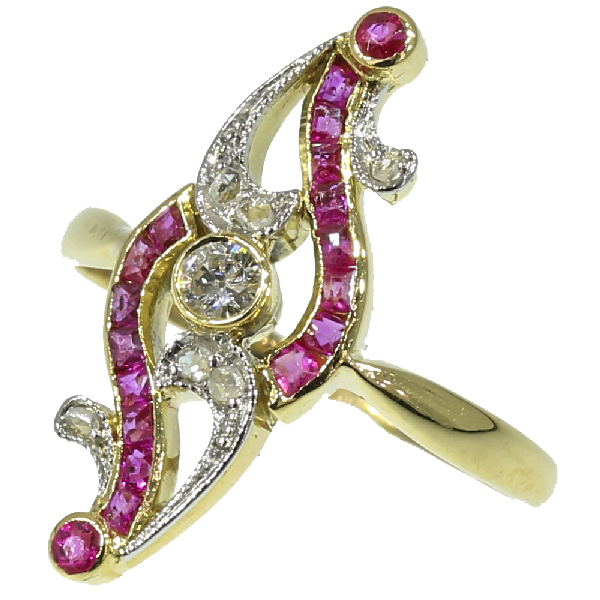

There’s no better way to demonstrate your love than by giving a ruby in celebration of a July birthday.Rubies are considered the king of gems and represent Love, Health and Wisdom.Click the pictures to get to each ring or here for all our ruby jewelry.

Romance In France
Oh la la, the French. They have such an eloquent way of expressing their romantic feelings for each other. Take a look at this pendant where we see a woman sitting at the shore, waving at a boat. The scene, which also features a flying swallow and is framed by roses, has the text: "Elle emporte vers vous mon baiser d'amour," which is French for "She brings to you my kisses of love." Does one need to say more?
Click here to get to this vintage romantic French love pendant.

It's Charleston Time!
The Charleston is a dance named after the harbour city of Charleston, South Carolina. The rhythm was popularised in mainstream dance music in the United States by a 1923 tune called "The Charleston" by composer/pianist James P. Johnson. This tune originated in the Broadway show Runnin' Wild and became one of the most popular hits of the decade. Runnin' Wild ran from 29 October 1923 through 28 June 1924. The peak year for the Charleston as a public dance was mid-1926 to 1927.
Click here to get to this French Art Deco diamond bracelet.

Antique Peep Show
Peep show, children’s toy, and scientific curiosity, usually consisting of a box with an eyehole through which the viewer sees a miniature scene or stage setting, painted or constructed in perspective. Peep shows of an earlier time are often the only accurate representation of the stage design and scenery of the period.
The earliest known peep shows are the perspective views said to have been painted in transparent colours on glass and lighted from behind for various effects, from sunshine to moonlight, by Leon Battista Alberti in 1437. Later models (some preserved in the Kunsthistorisches Museum in Vienna) have designs that are apparently patterned on Renaissance court masques and pageants, such as that of the discovery of Diana by Actaeon, with fully modelled figures set against a background painted in careful perspective.
In the 17th century, peep shows in their cabinets were often exhibited in the streets by itinerant showmen, and the device became a popular children’s toy. Some, equipped with movable scenery and wooden or cardboard figures, developed into the juvenile theatres of the 19th century (see toy theatre). The peep show was also the precursor of many types of optical toys, including the stereoscope and the magic lantern. (Source: www.britannica.com)
Click here to get to this Victorian antique ring with stone cameo.

Born in 1755, a touch of history
Marie Antoinette (Austria 1755 - Paris 1793), became the wife of Louis XVI and thus Queen of France. She supported the American Revolution in 1776 and the American Revolutionary War, and helped inspire a conservative reaction in France after 1791. This conservative reaction saw its greatest manifestation in the War in the Vendée, which led, several years after the queen's death, to the end of the Revolution and the return of conservative and religious ideas in France and Europe. She was beheaded on the guillotine on 16 October 1793.
The note we show is supposed to be her last note. These heartbreaking words - the last that Marie Antoinette had written in her cell, with traces of her tears making it even more moving - were found on the first page of her prayer book:
4h in the morning...
My God have mercy on me!
My eyes have no more tears to cry for you my poor children;
farewell
farewell!
Marie Antoinette
Also "born" in 1755 is the depicted ring. It was made in Amsterdam, and on its journey through time with a layover at Adin, it was exhibited together with Dutch Royal Jewellery in 1962. Just imagine the stories we would hear if our antique jewellery could speak.

Snake hunting in The Garden of Adin
The serpent is one of the oldest and most widespread mythological symbols. Considerable overlap exists in the symbolic values that serpents represent in various cultures. Some of this overlap is due to the common historical ancestry of contemporary symbols. Much of it, however, is traceable to the common biological characteristics of snakes.
A lot can be said about snakes and serpents. They have been worshipped since the Dark Ages and are a powerful religious symbol with many different meanings, such as death and resurrection. They have also been associated with healing and river gods, denoting fertility, wisdom, and the ability to cure.

Dropped in The Garden of Adin

Magical Feathers in The Garden of Adin

The Adin Museum of Fairy Tale Artifacts cautiously brings you new proof of theory of evolution?

The crow and the fox
Important Background Information brought to you by The Adin Museum of Fairy Tale Artifacts:
We are all familiar with Aesop's fable (620–564 BC) in which a clever crow, having found a piece of cheese, perches on a branch to enjoy it. A fox, desiring the cheese for himself, flatters the crow, calling it beautiful and wondering whether its voice is as sweet. When the crow lets out a caw in response, the cheese falls, and the fox swiftly devours it.
What many people do not know, however, is that after this incident, the crow sold the story to Aesop. From the royalties, the crow treated himself to a fine bar brooch, featuring the head of the fox depicted on it.
It is with great pride that The Adin Museum of Fairy Tale Artifacts presents evidence of this tale, offering a picture of the crow proudly wearing the very brooch. And—oh, the coincidence!—this specific brooch just happens to be part of the Adin collection.
Click here to get to this Victorian diamond set fox head bar brooch.

The Garden of Adin presents you: Relaxation in the Roaring Twenties
Abstract motifs and geometrical forms are quite typical for the Art Deco period. Art Deco moved away from the soft pastels and organic forms of its style predecessor, Art Nouveau, and embraced influences from many different styles and movements of the early 20th century, including Neoclassicism, Constructivism, Cubism, Modernism, and Futurism. Its popularity peaked in Europe during the Roaring Twenties and continued strongly in the United States through the 1930s. Although many design movements have political or philosophical roots or intentions, Art Deco was purely decorative.
Click here to get to this ring of the Roaring Twenties.
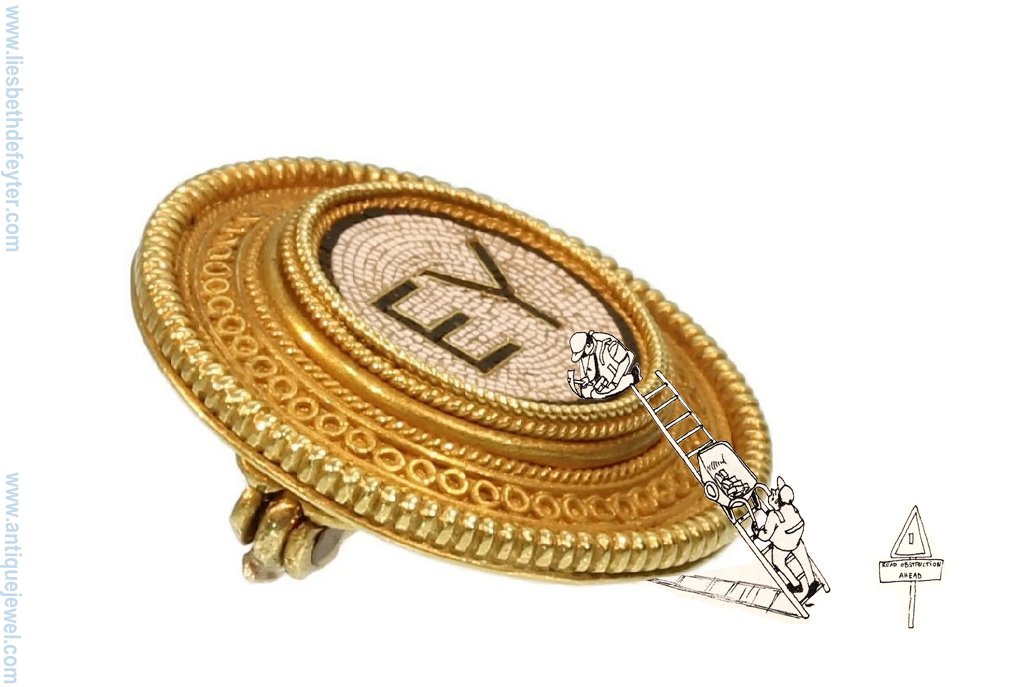
Road works in The Garden of Adin. We apologize for any inconvenience this may cause.
All foolishness with our weekly pictures aside, we at Adin take our job as antique jewellers seriously. It is our goal to make our collection of antique jewellery as interesting for you as possible. Hence, this brooch by the famous 19th-century jeweller Castellani. Renowned for recreating jewellery in ancient styles, particularly Etruscan, his work became fashionable and highly sought after in 19th-century Europe and America. Castellani is a name to be found at the top of the wish list of every avid antique jewellery collector.

Easter at The Garden of Adin: Who says you need to be Fabergé to decorate an egg?

The Garden of Adin: "The land flowing with milk and jewelry"
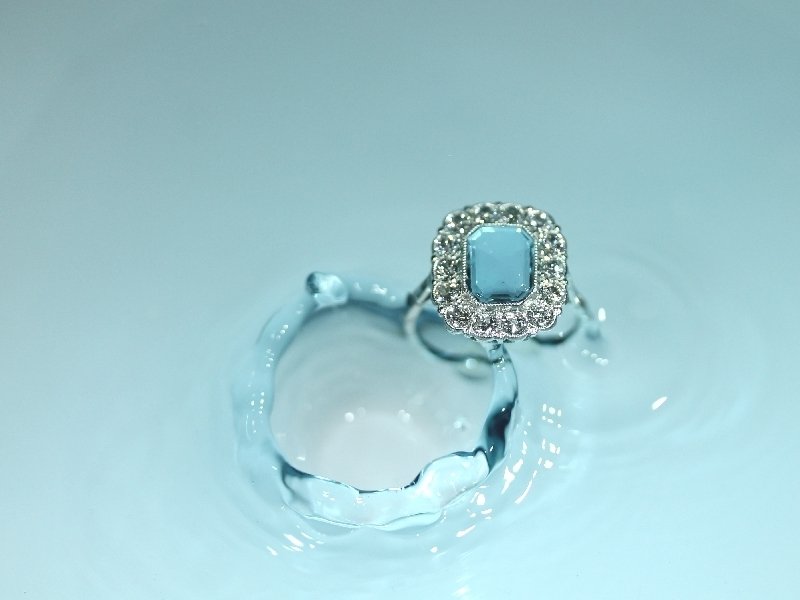
Out of the Blue: Aquamarine Ring!

Newsflash from The Garden of Adin: Easter Bunny takes rest in anticipation of upcoming stirr

The Adin museum of Fairy Tale Artifacts proudly presents: The original Frog Prince bracelet !
Many of us know the fairy tale of the princess kissing a frog, who then magically transformed into a handsome prince. For a long time, the existence of an image capturing the moment of their first encounter has been a source of dispute among leading historians worldwide. It is only recently that Mr. Elkan Wijnberg, chief conservator of the Adin Antique Jewellery Museum of Fairy Tale Artifacts, revealed that the museum had found the original picture! Even more coincidentally, the bracelet the princess is wearing in the picture happens to be in Adin's museum collection too!

Variation to the theme 'tennis bracelet'
Normally, a tennis bracelet is an in-line diamond bracelet or a bracelet that features a symmetrical pattern of diamonds. Tennis bracelets have existed much longer than the term used for them. In 1987, Chris Evert, the former World No. 1 woman tennis player, was playing in the U.S. Open. She was wearing an elegant, light in-line diamond bracelet, which accidentally broke, and the match was interrupted to allow Chris to recover her precious diamonds. The "tennis bracelet" incident sparked a new name for the item and ignited a huge jewellery trend. Tennis bracelets continued to be worn by various tennis stars like Serena Williams, Gabriela Sabatini, and Diana Kerrison. Before this, they were just called rivière or inline bracelets.

A picture is worth a thousand words - a small history lesson.
It is believed that in 1911, around the period when this ring was made, the expression "Use a picture. It's worth a thousand words." was used for the first time. It appeared in an article in the New York newspaper The Post-Standard, quoting newspaper editor Arthur Brisbane discussing journalism and publicity.
Click here get to this antique ring with old mine diamonds and Verneuil ruby.

To celebrate my love for you, I will gather these jewels of dew. Happy Valentine!

Antique jewellery, so much to wonder about....

Baroque rose cut diamond ear jewels, About 350 years old!
Three graduating teardrop-shaped high domed rose cut diamonds are surmounted by three rose cut diamonds in a V-shape with additional scrolling, attached to a larger round high domed rose cut diamond. The diamonds are set in a closed silver setting, and the edges are decorated with a small lobed border. The pair of earrings is finished with a gold backing, a popular method for this time as the silver ensured the natural sparkle of the diamond is optimised, while the gold layer prevented the silver from tarnishing the skin. This particular gold backing is rather special because a second decorative border of delicate striations is added.
The additional scrolling on the connecting part, the height of the rose cut diamonds, and the double layer of decorative applications to the earrings ensure us that only the highest level of materials and craftsmanship were used in fashioning this pair of earrings. That they stood the test of time in such good condition is a testimony to this level of excellence.
Click here to read all about this top notch Baroque rose cut diamond ear jewels.

Victorian gold bracelet with Japanese sceneries in damascene technique
The first thing noticeable about this magnificent bracelet is the high-quality craftsmanship required to create the lovely scenes on each link. Eight little pieces of art, each telling its own story in low relief in various colours of gold. We have a strong feeling that these scenes refer to one or more (Japanese?) stories or fairy tales, but we were unable to trace back more information on them. The technique used here is called "Damascening", "zougan", or "shakudo", which is the art of inlaying different metals into one another. This technique has a long history in Japan, where it was used to decorate sword fittings. Just take a look at the individual picture of each link and be as amazed as we are.
Click here to read all about this Victorian damascene bracelet.

A bee or not a bee... That's the question!
This Victorian insect brooch, which we believe represents a bumblebee, was likely made in Belgium around 1880. Bees are a symbol of diligence and indefatigable effort. Set with Verneuil rubies and half-seed pearls, this brooch makes a charming shoulder decoration.
Click here to read all about this gold antique insect brooch.

Oh My! We almost forgot to wish you a Happy New Year!
So, Happy New Year
and thank you for having the good taste
to call upon our antique jewelry expertise.